
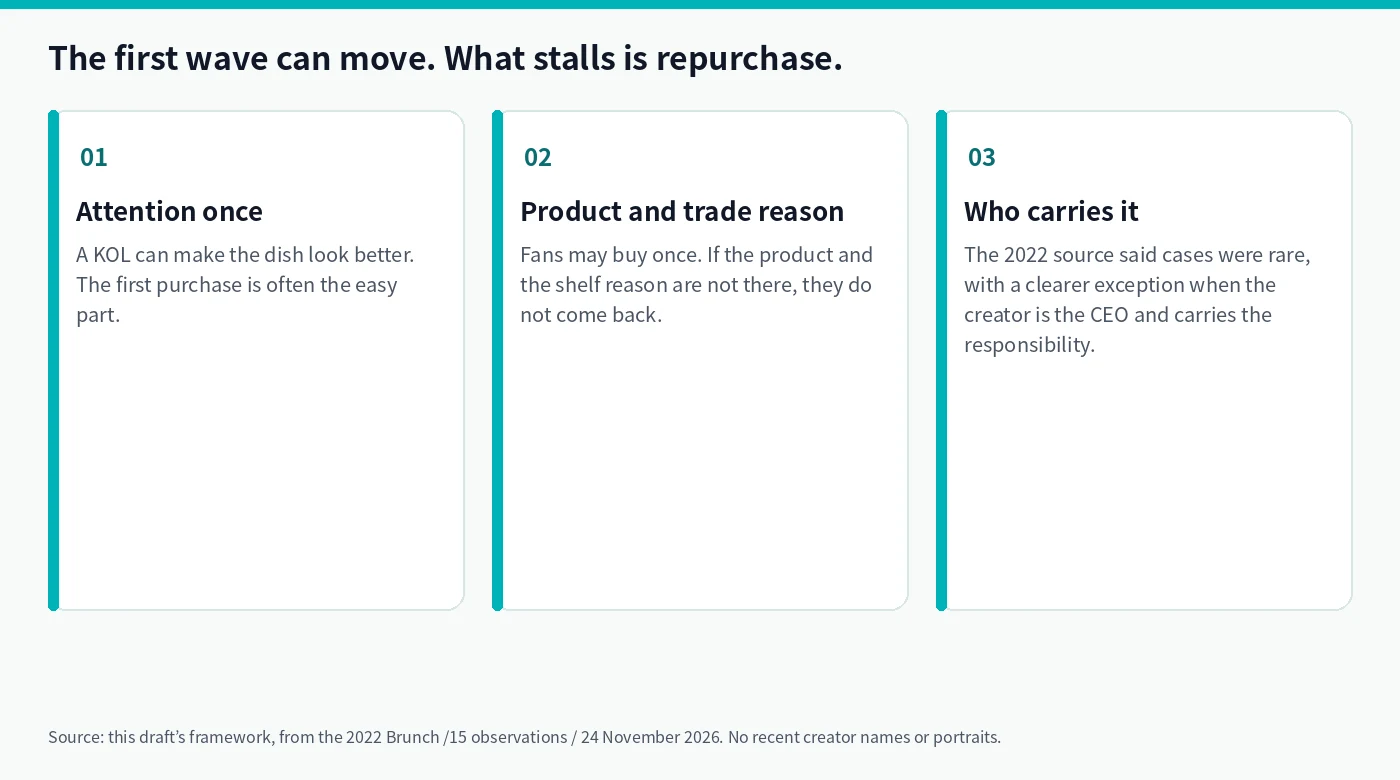
The short answer. A product with an influencer or KOL behind it often moves in the first wave. It is harder to sustain, and the usual reason is repurchase. The 2022 source said successful cases were rare, with a clearer exception when the creator is the CEO and carries the responsibility. A KOL can make the dish look better. They are rarely the ingredient itself. Fans may buy once. If the product and the trade reason are not there, they do not come back.
This is not a translation of the 11 April 2022 Brunch article. It uses the same observations, written for Singapore teams looking at a tie-up or a creator-led line.
What this article covers
- Why a fast start is not the same as a brand that lasts
- How to separate the spark from the product
- Why the brand and the creator often talk past each other
- When to use the creator’s face, and when to fade it
- What Singapore teams should check on disclosure
A fast start is not the same as a brand that lasts
Using influencers or KOLs is still a serious tool, in beauty and outside it. People who already sit close to the customer can carry a name and a purchase. That is why co-created lines keep appearing. The 2022 source accepted that much.
Its conclusion was still blunt. Few of these brands really work. The exception it allowed was when the influencer is the managing director and owns the outcome. A joint product with a large company can look clean on a slide and still fail to last. That was the 2022 position.
The same article was written, then, from the seat of a marketing firm running “around 480 collaborations a year with influencers”. That 480 figure is from the 2022 article. It is not this year’s count.
In this Singapore article, “influencer” and “KOL” are used together on purpose. Both are ordinary in Singapore. “KOL” is especially common with Chinese-speaking teams and with platforms such as Xiaohongshu (RED). The mechanism — a first-wave buy, then a repurchase problem — does not change with the label.
Data (source: Brunch, 11 April 2022; checked: 24 November 2026):
Google in Singapore, as of 22 November 2026, showed “influencer marketing” and “influencer marketing agency” at 210 monthly searches each, with a high CPC (2.18). That is a broad query, not proven to be beauty-only, and the weekly Trends series was unstable. It is a small, expensive-looking trade query, not evidence of a large KOL-brand boom.
Data (source: treg SE Ranking, as-of 22 November 2026; checked: 24 November 2026):
Separate the spark from the product


The source used a simple picture. The food has to exist first. The influencer makes it more vivid. A spark on its own cannot make the meal.
Fans will often buy a project once, because that person is in it. A brand that lasts still needs repurchase. The ability to make a launch visible, and the substance of the brand, are not the same. Without the second, the first peak has nowhere to go.
The 2022 article also described a project with three creators, sold as “the cosmetics we made”, that went as far as outdoor ads and then failed to hold. The reason given was that several companies sat in the middle, communication stalled, and the brand’s direction and the makers’ intent never arrived in one piece. Names were already withheld in the source. They stay out here. What remains is the observation: if motivation and the message are diluted halfway, the period after the first sale is weak.
Why the two sides talk past each other
The 2022 article also pointed at structure. It said that, in Korea at that time, influencer pricing was high by global standards, and that MCN, investment and finance had pushed ad rates up. That is a 2022 observation, not a 2026 rate card for Singapore or Korea.
It also contrasted talent who may be tied more tightly to a brand when they are hired as a face, with influencers who can be paid by piece of content and still keep rights income. Under conditions with no editor or go-between, it said operating margins could swing around 90%. That 90% figure is from the 2022 article. It is not used here as a current average.
That gap is where the talk starts to slip. One side sees a fee after a video. The other is holding stock, selling it, making it again, and waiting for a second purchase. Time does not feel the same. The source said both positions are understandable, and then said beauty still has to move with the market and the trade. Creator-led brands often try to sit inside the demand their fans already have, rather than fit the trade. The first curve is usually good. Without repurchase and a real market, it is hard to last.
Singapore teams should also treat disclosure as a separate check. Paid or gifted posts need to be clearly marked under local advertising standards, including ASAS guidance on influencer marketing. The 2022 source does not cover those rules. This article flags them; it does not reprint a checklist. Confirm the current wording before a campaign goes out.
Unverified: The current full text of ASAS guidance, not quoted here.
Data (source: 2022 article’s then-rates and margin remarks):
Use the person first, then fade the face
The exception the source kept was the case where the creator takes responsibility, does not lean on a corporate joint venture, and keeps working for repurchase. In that case, the article said, you get past mere exposure, and you start to see both craft and continuity.
The practical sequence it offered was: use the person’s image as hard as you can at the start, then from around the three-month mark fade the influencer colour and move to a brand image of its own. The public example it named was TIRTIR, started in 2017 by an influencer, with the person in front at the beginning and that colour later reduced so the brand could stand in the market. That is a 2017 public market case, not a recent Beaus client story. This article does not verify TIRTIR’s 2026 sales rank.
Data (source: Brunch, 11 April 2022; TIRTIR cited as a 2017 public example; checked: 24 November 2026):
Unverified: That brand’s 2026 sales rank
In one line: understand the system (trade and repurchase) first, then fade the personal colour on purpose. If you design only for the fan’s first purchase, month four is empty. How Beaus works with creators is described on BROUND and the beauty MCN guide. The same MCN page in Simplified Chinese is at zh-SG BROUND.
By the data
Source: BEAUS COMPANY's own data collection. Olive Young daily Best 100 snapshots 2026-10-13 to 2026-11-26 (45 days), the 18:15 snapshot on 2026-11-10 and product-detail snapshot on 2026-11-10.
Facts
- Here 'OO PICK' means a label such as “[OO PICK]” at the front of a product name, where OO is usually a person's name or nickname.
- In the daily Best 100 (45 days), items with an 'XX PICK' label in the name (Olive Pick excluded) ran from 0 to 12 a day, median 7.
- At 13:20 on 2026-11-26 there were 6.
- In the 18:15 Best 100 on 2026-11-10, of 95 items matched to detail-page review counts, the 6 PICK-labelled items had a median of 22,217 reviews and the other 89 had 10,902.
PICK-labelled items had about twice the median reviews of the rest
95 Best 100 items with review counts, 2026-11-10 18:15 · median reviews
- PICK-labelled6 products22,217
- All others89 products10,902
Source: BEAUS COMPANY's own data collection. PICK counted from the product-name string (Olive Pick excluded). 6 items is a small sample. This data does not show cause.
Our read
Set PICK labels next to review counts and the PICK items sit higher. We do not know why. PICK may have lifted reviews, or PICK may have been attached to products that already had many reviews. Causation is a hypothesis. Six items is a small sample.
By BEAUS COMPANY's own collection, in Olive Young's Best 100 at 18:15 on 10 November 2026, the 6 PICK-labelled items had a median of 22,217 reviews versus 10,902 for the other 89 with known review counts.
Limits: PICK labels are counted from product-name strings (Olive Pick excluded). The sample is small and shows no causation. Review counts are not sales.
FAQ
Do influencer or KOL brands not work?
They often start fast, the 2022 source said. The reason they struggle to last is repurchase. The clearer exception is when the creator is the CEO and owns the outcome.
Is a first wave of fan purchases enough?
No. A brand that lasts needs substance, a reason to stay in trade, and a second purchase.
When should the creator’s face be faded?
The source’s rule of thumb was to use the person at the start, and fade the colour from around three months. That is not a tested schedule for every campaign.
What extra check applies in Singapore?
Paid collaborations should be disclosed under local advertising standards, including ASAS guidance. That requirement is not in the 2022 source. Confirm the current text before you publish a campaign.
Are “480 collaborations” and “90% margins” current?
No. Both are figures from the 2022 article.
Key takeaways
- The core problem is repurchase, not the first spike.
- A KOL or influencer is the spark, not the product.
- The 2022 practical sequence is: use the person first, then fade the face.
- Figures are as of 2022. Singapore disclosure rules need a separate check.
Source: 인플루언서 브랜드는 왜 잘되기 어려울까
Sources
- Data: Jinho Park, “인플루언서 브랜드는 왜 잘되기 어려울까”, Brunch, 11 April 2022. https://brunch.co.kr/@jinhorus/15 . Repurchase, 480 collaborations (then), the anonymous joint project, 90% margin remark (then), fade after about three months, TIRTIR (2017). Checked 24 November 2026.
- Data: treg SE Ranking, as-of 22 November 2026. “influencer marketing” / “influencer marketing agency” 210, CPC 2.18. Weekly Trends unstable.
- Unverified: 2026 collaboration counts, current rate cards, TIRTIR’s current rank, the full current text of ASAS guidance.