
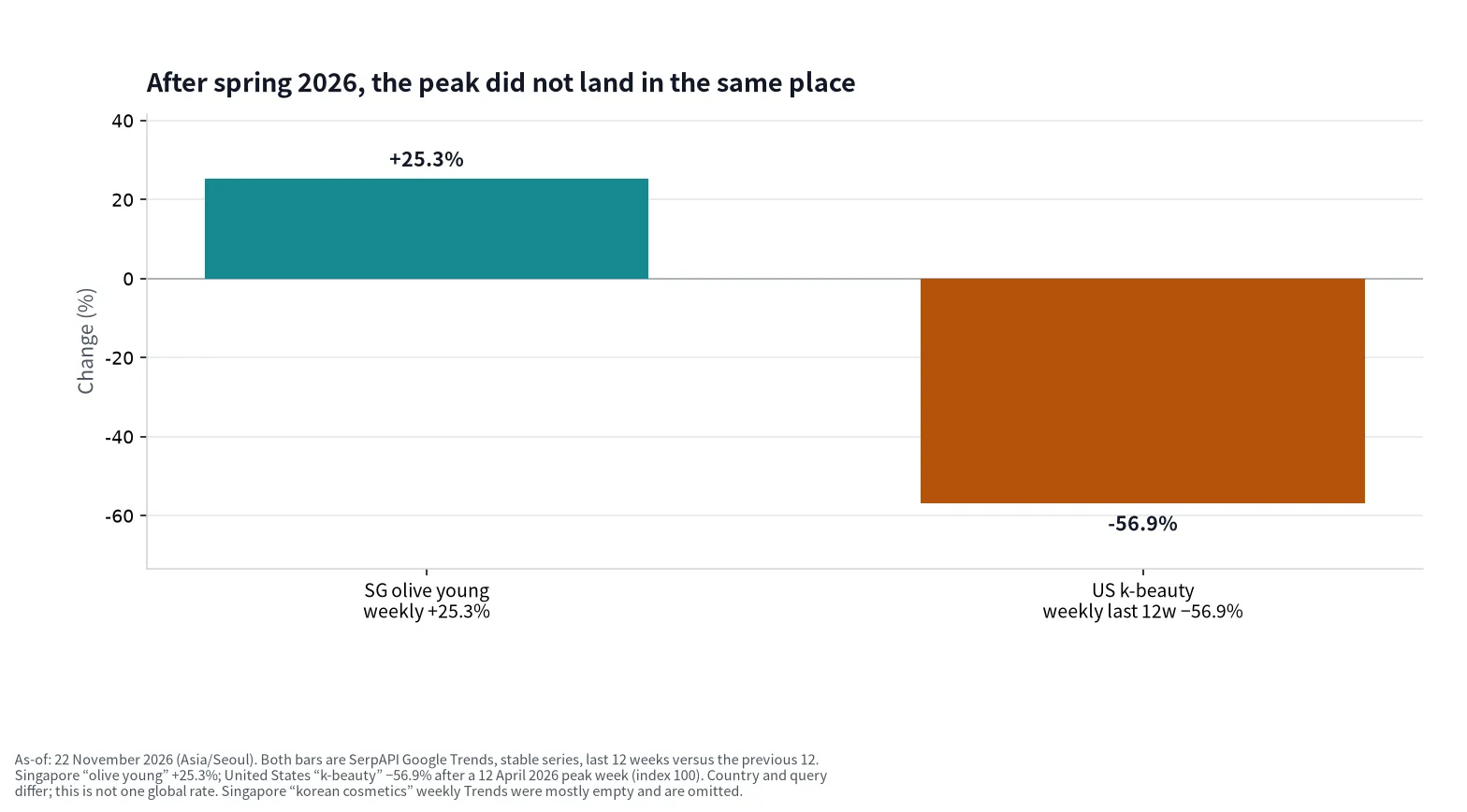
The short answer. If you read K-beauty’s next move only from the heat around the letter “K”, you will be off. The 2022 source asked a more basic question: is it K-beauty because it is made in Korea, because a Korean celebrity is the face, or because the campaign looks Korean? Google search as of 22 November 2026 also shows that the peak did not land in the same place in every country. In the United States, “k-beauty” interest jumped in spring 2026 and then cooled. In Singapore, the cleaner weekly signal is the store name “olive young”, not a general K-beauty boom. What is worth watching is whether you can deliver the same quality locally, and whether people come back to the brand.
This is not a translation of the 14 April 2022 Brunch article. It does not reuse that article’s then-market commentary or named brand success stories. It keeps the argument about definition, localisation and repurchase.
What this article covers
- Why the letter “K” is not a definition
- How search interest after spring 2026 differs by country
- Why local manufacturing quality and brand repurchase should be read separately
- Why this draft does not invent a 2026 market size
Is it K-beauty just because it has a “K”?
The 2022 source said that “K-beauty” was already being used freely in news and policy, while the image behind the word was not shared. The questions it left open still help:
- Is it K-beauty if it is made in Korea?
- Is it K-beauty if a Korean celebrity is the model?
- Is it K-beauty if you add a Korean-looking costume or set?
The article described a US Sephora display that used a Korean-looking presentation to promote sheet masks, and asked whether that was the substance of K-beauty. Presentation travels. It is not a definition.
The same article noted that in consumer electronics, people still talk about brand value even when the factory country changes, while beauty is more often framed inside a “K”. In Singapore the same blur appears. “Made in Korea”, “a Korean brand’s equity”, and “this season’s Korean look” are not the same thing.
[Data / language ko, country KR / source: Brunch, 14 April 2022 / checked: 24 November 2026]
After spring 2026, interest did not stay in one shape
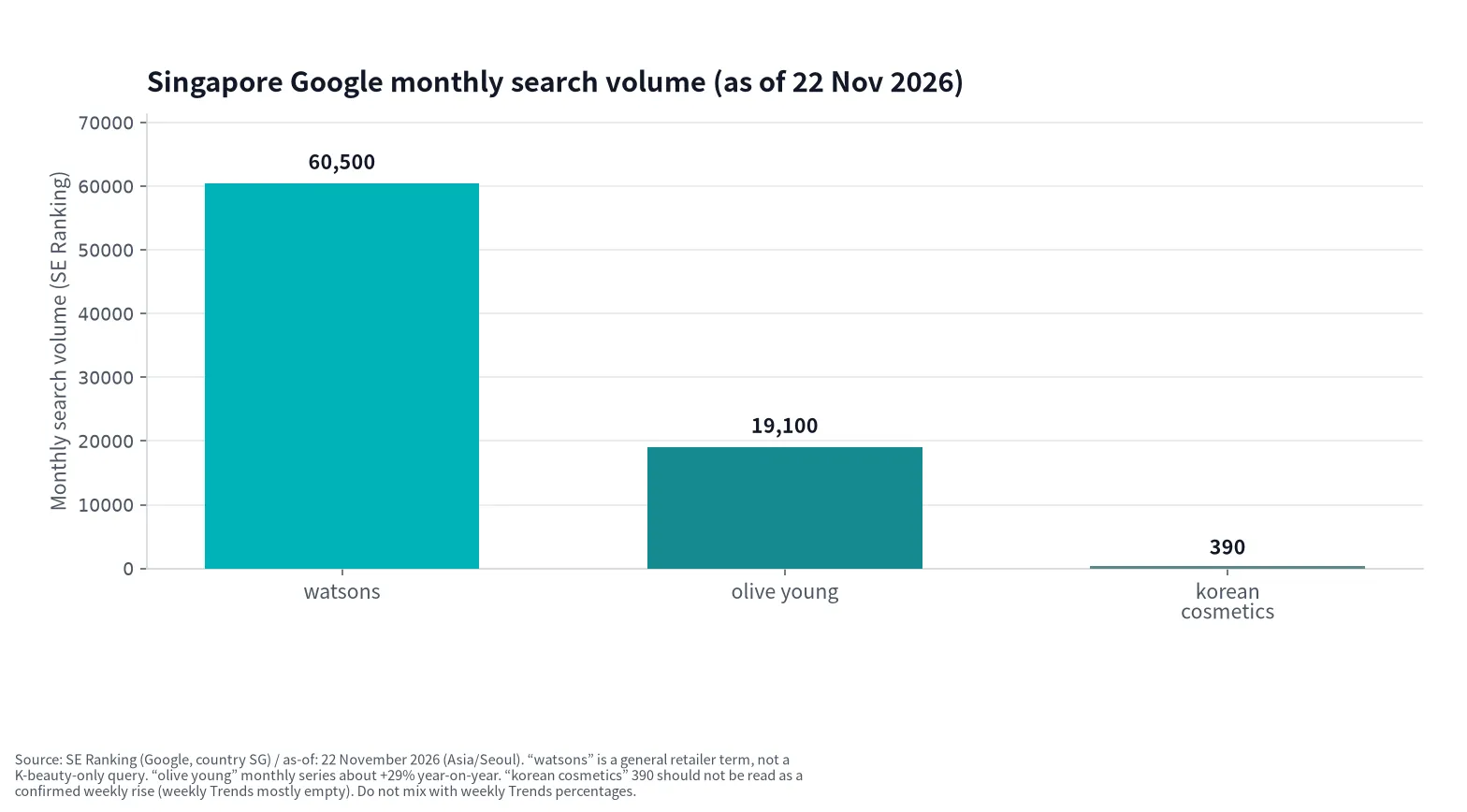
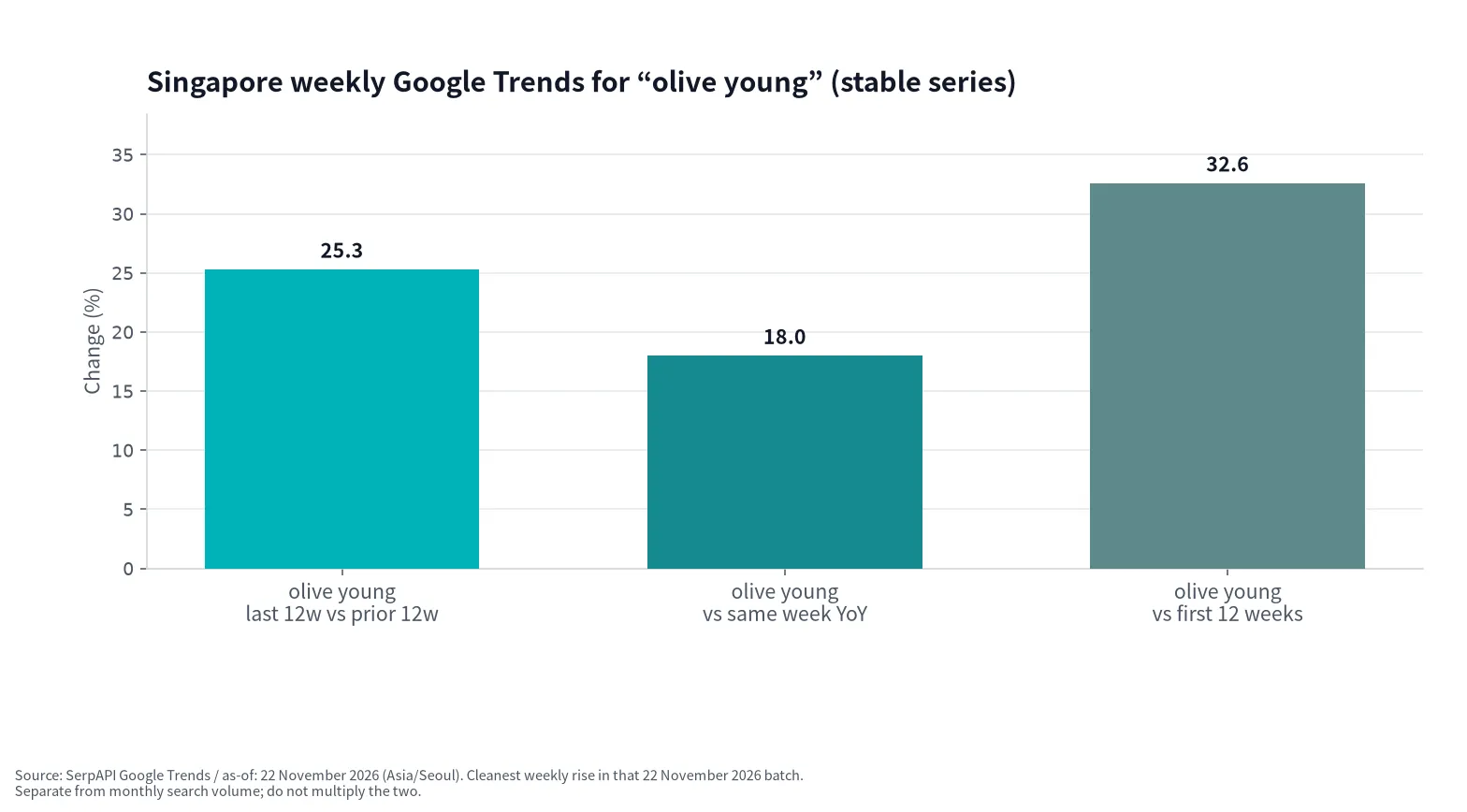
This draft does not use 2022 market-size figures or government investment totals as if they were current. Instead it uses a Google check dated 22 November 2026 (Asia/Seoul). Search volume and Google Trends are not the same measure.
| Observation | Measure | Value | Note |
|---|---|---|---|
| Singapore “olive young” | Monthly search volume (Google, country SG) | 19,100 | Largest term in this set. Year-on-year about +29% on the monthly series |
| Singapore “olive young” | Weekly Trends (stable series) | Last 12 weeks +25.3%; +18.0% versus the same week a year earlier; +32.6% versus the first 12 weeks | The cleanest weekly rise in the 22 November 2026 batch |
| Singapore “korean cosmetics” | Monthly search volume | 390 | Monthly series was gently up (+14.6%). Weekly Trends were mostly empty, so that rise is not confirmed weekly |
| Singapore “korean skincare” | Weekly Trends | Last 12 weeks −16.4% | Not the same direction as “olive young” |
| Singapore “k beauty” / “korean beauty” | Monthly search volume | 180 / 170 | Small. The “k beauty” weekly series was unstable |
| US “k-beauty” | Weekly Trends (stable series) | Last 12 weeks −56.9%; one-week year-on-year −60% | Index 100 in the week of 12 April 2026, then a lower autumn reading |
| US “k-beauty” | Monthly search volume | A separate series still looks high | Different definition from Trends; this draft does not treat either series as an error |
[Data / language en, country SG and US / source: treg SE Ranking and SerpAPI Google Trends, as-of 22 November 2026 / checked: 24 November 2026]
What this does not say is “K-beauty is still growing at the same speed everywhere”. In the US, spring 2026 was a peak, and relative interest then fell. In Singapore, the store name is the large, clean signal; the phrase “K-beauty” itself is small and unstable on the weekly series. If you open a Singapore article with “the US spring surge”, you will miss the local reading. The store, the buying path, and repurchase are closer. That is the same angle as the must-buy draft (https://beausglobal.com/insights/oliveyoung-must-buy-read-the-shelf).
Can you make the same quality locally?
The direction in the 2022 source was to take the “K” off, and return to brand value and the ability to make the same quality in market.
The public industry examples in that article were about manufacturing localisation: around 2019, Korean manufacturers set up plants abroad so they could make at the same standard as at home; another manufacturer was described, in a conversation at the time, as being able to make the same product at the same quality in several countries. The point is not a list of company names. The point is that the centre of gravity moves from “made in Korea” to “can we hold the quality wherever it is made”. Company names are left out of this draft, as they were in the Japan edition. 2026 output and results for those firms are unverified here.
[Data / language ko, country KR / source: Brunch, 14 April 2022, on manufacturing localisation around 2019 / checked: 24 November 2026]
[Unverified] Those firms’ 2026 output and results
Selling into Singapore is the same split. Shipping from Korea and fitting local rules, climate, and how the name is understood are different jobs. If you leave the second job late, only the “K” flag remains.
What remains is a brand people buy again
The 2022 article did not close on a new buzzword. It closed on a principle: a brand does not last without repurchase, and you have to put weight on the customers you already have. That basic marketing rule is not overwritten by each new trend.
That still holds when search interest now differs by country. Peaks move. What remains after the peak is a brand people return to. In Singapore, “must-buy” and store-name searches staying large is consistent with people still deciding what to buy next, not only discovering the category. That is an inference, not a measured repurchase rate.
[Inference / language en, country SG]
FAQ
Is K-beauty still growing?
It depends on the country and the measure. As of 22 November 2026, weekly US interest in “k-beauty” was down after the spring peak. In Singapore, “olive young” was up on the last 12 weeks, while “korean skincare” was down on the same weekly window, and “K-beauty” as a phrase was small. One growth rate will not cover it.
Does “take the K off” mean hiding Korea?
No. It does not mean hiding origin or manufacture. It means looking first at quality that works in market, and at a brand people buy again, rather than at the flag alone.
Why are 2022 market figures left out?
Using them as if they were 2026 facts would be wrong. Figures in this draft have a source and a date.
What should Singapore read first?
The heat around the word “K-beauty” is a weak first signal here. The store (Olive Young), how you buy it in Singapore, and whether people come back, are closer to the evidence we have.
Key takeaways
- The letter “K”, or a Korean-looking campaign, does not define K-beauty.
- Search interest after spring 2026 is not the same in every country.
- The direction that still holds is local quality and a brand people buy again.
- This draft does not invent a 2026 global market size.
Source: 저무는 K뷰티, 나아가야 할 방향은?
Sources
- [Data / language ko, country KR] Jinho Park, “저무는 K뷰티, 나아가야 할 방향은?”, Brunch, 14 April 2022. https://brunch.co.kr/@jinhorus/18 . Questions of definition, localisation of manufacturing, repurchase. Checked 24 November 2026.
- [Data / language en, country SG and US] treg SE Ranking and SerpAPI Google Trends, as-of 22 November 2026.
country-demand-treg.md. - [Inference / language en, country SG] Singapore should not be framed as “the US spring surge”.
- [Unverified] 2026 global market size; current results for manufacturers mentioned in the source; weekly confirmation of the Singapore “korean cosmetics” monthly rise.