
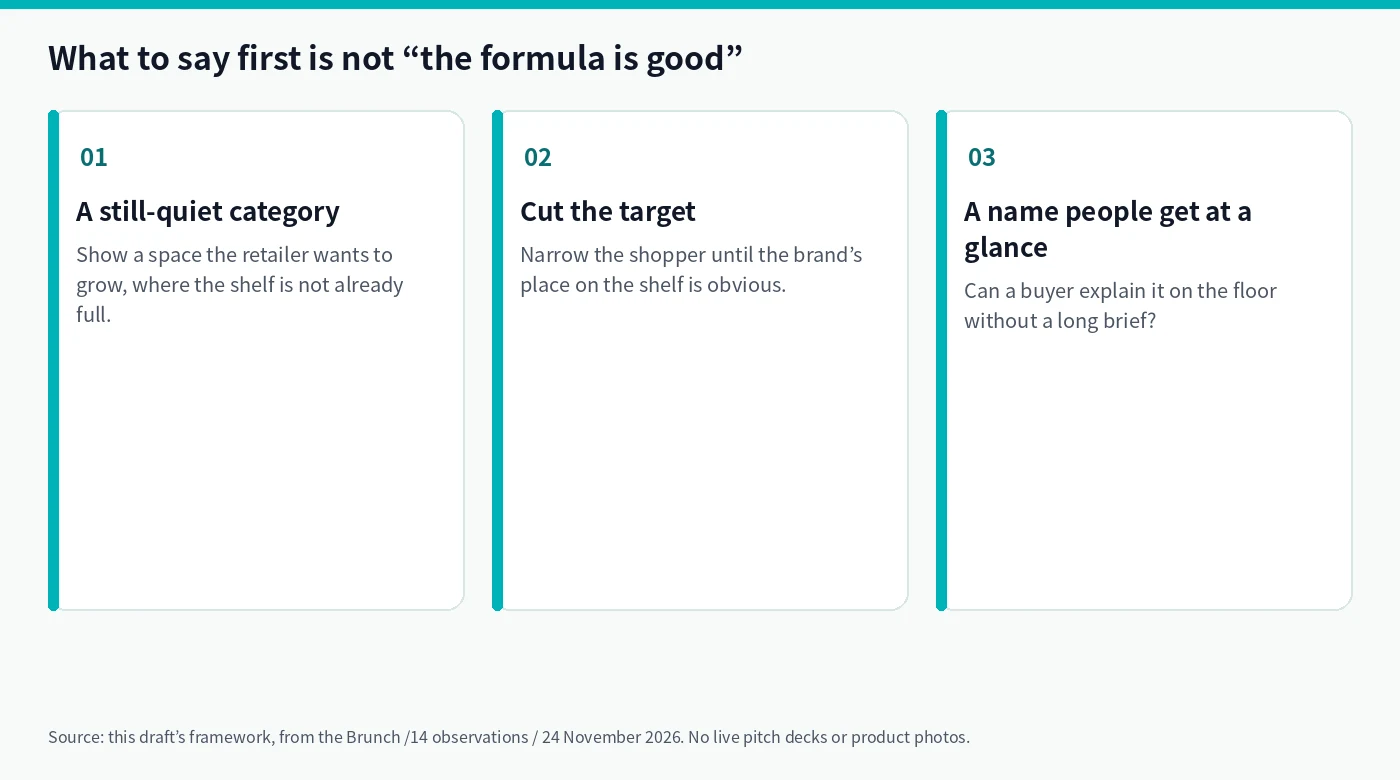
The short answer. Korean Olive Young does not open a slot because the formula is strong. It opens a slot when there is a reason the store can grow with the product, without cutting sales already on the shelf. After years of watching Olive Young private brands (PB), exclusive brands (EB) and their promotions, three patterns keep showing up: propose a category that is still quiet, cut the target until the brand’s place is obvious, and give the product a name people understand at a glance. What you should say first to a buyer is not “the ingredients are good”. It is “here is how this also grows Olive Young’s sales”.
This is not a translation of the 8 April 2022 Brunch article. It uses the same facts, written for teams in Singapore who are thinking about a Korea listing. It does not add today’s application process or current sales ranks. Unit figures are as of the 2022 article.
What this article covers
- Why “the formula is good” does not move a buyer
- What kind of category is easier to get through
- Why the same sunscreen is split so finely
- What a name has to do, for the buyer and the shopper
- Why a listing is the start, not the finish
Why “the formula is good” does not move a buyer
If you are building a beauty brand in Korea, it is hard not to think about Olive Young. The store’s weight is that large, and so is the bar to get on the shelf. There is very little public guidance on the conversation that actually works.
The shop floor looks full. Inside that, there is a quieter split: Olive Young’s own private brands (PB), the exclusive brands (EB) it puts weight behind, and brands that got famous first on social media. Brands compete with each other, and they also have to work with the platform.
The gap people miss is cannibalisation. A manufacturer can repeat “the formula is good; people who try it will know”. That is not what the buyer has to justify first. They need a reason to give this product a slot even if it means letting go of sales already on the shelf. Without that reason, a good formula still stalls at the proposal stage.
The listing decision sits with Olive Young. What you can do first is build a Korea response, and a reason the store is not just swapping one sale for another. The same order is set out in the foreign-brand listing guide, and in Simplified Chinese.
What kind of category gets through more easily?

The first pattern is to propose a new category, or one that is not yet crowded.
A public example is Kahi’s multi-balm. Branding and promotion played a part. The category mattered too. At the time, a multi-balm for lips and skin was still a small market, so from Olive Young’s side it looked like a product the store could grow with, without cutting existing sales.
ModaModa’s colour-changing shampoo sits on the same line. The idea was hair colour that shifts gradually, not a fight for first place on an already packed shampoo shelf. This is a public market example from around 2021, as mentioned in the 2022 article. Later debate around the product is a reason not to hold it up as a flagship case. It is here only to show the principle.
“We will take the number-one slot on a shelf you already have” and “we will bring demand you do not yet have a shelf for” sound completely different to a buyer. That is why the second pitch is easier to get through.
Why is the same sunscreen split so finely?
The second pattern is to cut the target until the brand’s place is obvious. It is already used in many categories. It still matters enough to keep.
Sunscreen is the clear example. It used to split mainly into mineral and chemical filters. It later split again, into tone-up sunscreens, so-called advanced-clean sunscreens, laser-care sunscreens, and other use cases.
Even inside “sunscreen”, the shelf and the product page have to show who it is for, in what setting, and for what job. If a listing pitch stops at “women in their twenties, skincare”, the buyer cannot see how it differs from brands already there.
Singapore retailers also cut categories finely. This draft still uses only the Korea Olive Young split in the source article. It does not add figures for Watsons, Guardian or Sephora Singapore.
What does a name have to do in one glance?
The third pattern is a name that works as a keyword, not as a long line of copy.
A polished paragraph will not beat a name that stops the eye. The 2022 article used Korean examples such as “집착헤어팩” (a “go-all-in” hair pack) and “이별세럼” (a “goodbye” serum). Abstract language only gives the shopper more to think about. The name has to be obvious on the shelf, in search, and in a hashtag.
In a crowded hair-loss shampoo market, Luton stood out with “shampoo for women’s hair loss”. Reviews at the time showed people buying after seeing that phrase as a hashtag.
In skincare, Goodal’s “two-week goodbye to dark spots serum” had, as of the 2022 article, passed 4 million bottles in cumulative sales. The name already said who it was for, what it was, and over what period. The 4 million figure is from the 2022 article. It is not a current total.
If you sell the same product in Singapore, claims in the name still have to be checked against local advertising rules. The examples above are observations of names used on Korean shelves.
Why do brands and Olive Young talk past each other?
Olive Young is measured on sales growth. Brands often start with world-view and branding. The vocabulary is different.
So a first meeting that opens only with brand story is harder to get through. Lead with the conclusion: “This is how Olive Young’s sales also grow. These are the moves.”
That is also why Beaus looks at planning and performance together. If you walk in with a generic beauty-industry pitch, and not a reading of PB, EB, and how the platform and the brand have to grow together, the listing is harder to defend later. A listing is the start, not the finish. If you cannot find a way for the store and the brand to live side by side, you will not hold the slot.
How you choose a channel at all is a separate question, taken up in the Olive Young versus Sephora draft (https://beausglobal.com/insights/oliveyoung-vs-sephora).
FAQ
What is the core of an Olive Young listing pitch?
Not a speech about how good the formula is. A reason the store can grow with this product without giving up sales it already has.
What are PB, EB and social-first brands?
The shelf includes Olive Young’s own private brands, exclusive brands the retailer is pushing, and brands that became known first on social media. A pitch has to show where you stand in that structure, and whose sales you will not overlap.
Why is a new category easier?
In a large existing category, cannibalisation is more likely. Public examples in the 2022 article — Kahi’s multi-balm, ModaModa’s colour-changing shampoo — were, at the time, small markets or new usage, which made it easier to grow with the platform.
How direct does the name need to be?
Direct enough to read on the shelf and in social posts at a glance. Luton’s “shampoo for women’s hair loss” and Goodal’s “two-week goodbye to dark spots serum” put the audience and the outcome in the name. Goodal’s 4 million bottles is a 2022 article figure.
Is a listing enough?
No. The platform and the brand use different language. From the first pitch, you need a way for sales to grow together, or the slot is hard to keep.
Key takeaways
- The pitch that gets through is not “the formula is good”. It is a reason the store can grow without cutting existing sales.
- The three tests are a quieter category, a sharper target, and a name people get at a glance.
- Examples and unit figures are public market cases from the 2022 article.
- A listing is the start. Speak in the store’s language first.
Source: 올리브영 입점 꿀팁 3가지
Sources
- [Data / language ko, country KR] Jinho Park, “올리브영 입점 꿀팁 3가지”, Brunch, 8 April 2022. https://brunch.co.kr/@jinhorus/14 . PB, EB, social-first brands, cannibalisation, Kahi, ModaModa, sunscreen splits, Luton, Goodal 4 million bottles as of 2022. Checked 24 November 2026.
- [Inference / language en, country SG] Rewritten with Singapore trade terms: listing, buyer, cannibalise, private brand. No local-chain figures added, because they are not in the source.
- [Unverified] The 2026 listing process, current sales ranks, Goodal’s current cumulative sales.