
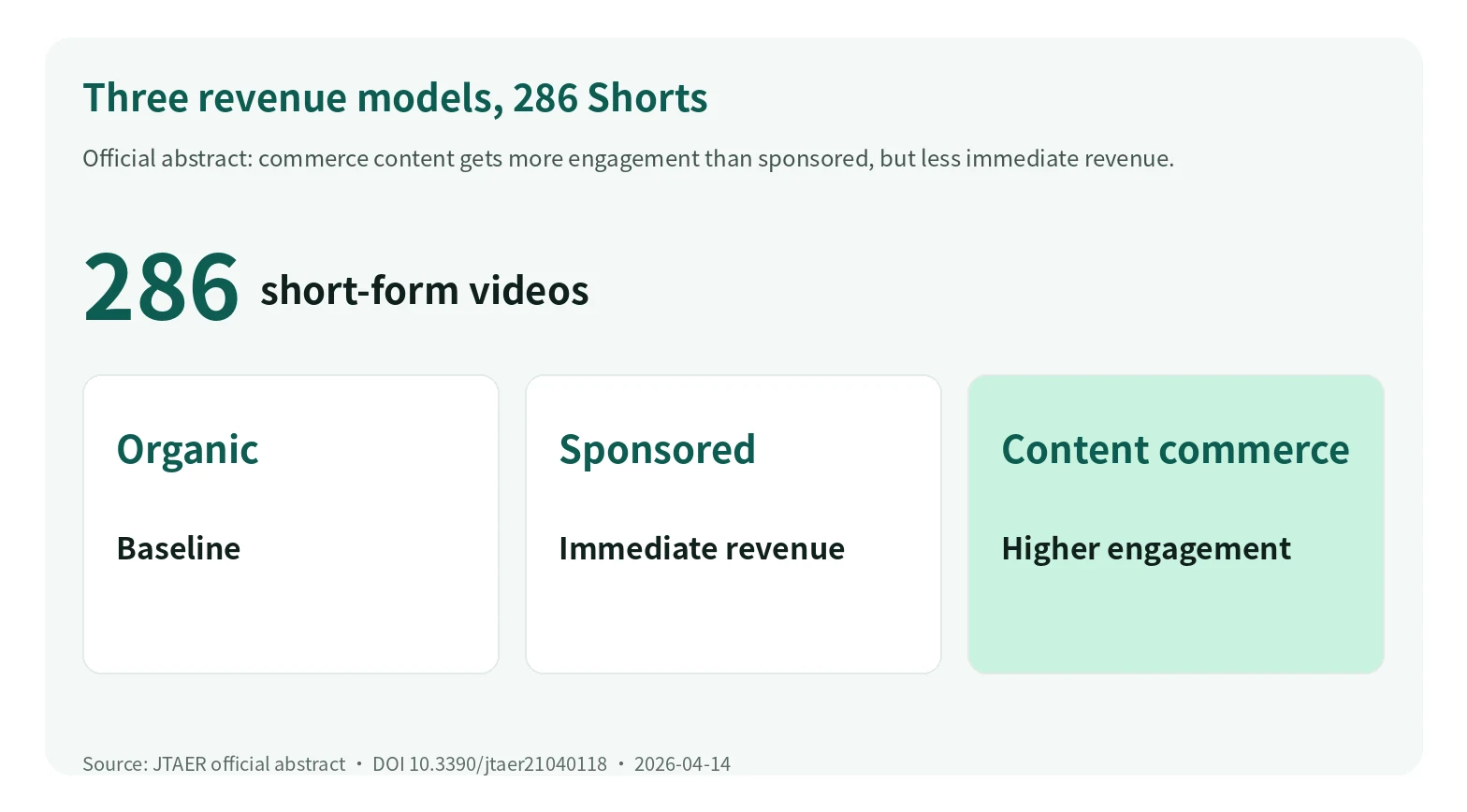
Commerce wins attention. Sponsored wins revenue now.
Rethinking Commerciality: How Content Commerciality Contributes to YouTube Beauty Content Performance
Jaeyoung Park · Sewon Eom · Eugene Choi · Jinho Park · Seongcheol Kim* * Corresponding author
Does looking like an ad always hurt? The official abstract does not treat that as a single answer. Content-driven commerce earned more engagement than sponsored videos, but less immediate revenue. The paper, written with Prof. Seongcheol Kim's team and Jinho Park, was published open access in JTAER on 14 April 2026.
Bibliographic details
- Title
- Rethinking Commerciality: How Content Commerciality Contributes to YouTube Beauty Content Performance
- Journal
- Journal of Theoretical and Applied Electronic Commerce Research 21(4), 118
- Published
- 2026-04-14
- DOI
- https://doi.org/10.3390/jtaer21040118
- Open-access article
- https://www.mdpi.com/0718-1876/21/4/118
- Official PDF (publisher link)
- https://www.mdpi.com/0718-1876/21/4/118/pdf — We do not host the PDF file on this site, for copyright reasons.
- Affiliations
- (1) College of Media and Communication, Korea University, 145 Anam-ro, Seongbuk-gu, Seoul 02841, Republic of Korea (2) Beaus Company Co., Ltd., 12F, Kyungwon bld, 340, Gangnam-daero, Gangnam-gu, Seoul 06242, Republic of Korea
Official abstract (English)
The abstract below is the official text on the MDPI article page. The paper is open access (CC BY). Please read the article and the official PDF on the publisher's site. We have not uploaded a PDF file here.
Creative expression is no longer separate from monetization. It is increasingly structured by the business models that platforms provide. Content monetization has evolved rapidly: early models focused on advertising revenue, followed by brand partnerships, and most recently, the integration of commerce-oriented features at the platform level. YouTube, for example, launched its YouTube Shopping service in South Korea in June 2024, enabling creators to sell products directly through their content. This development demonstrates that commerciality has become intrinsic to the creator economy. While prior research has emphasized factors such as authenticity, less focus has been placed on commerciality itself. This study addresses this gap by analyzing how varying levels of content commerciality affect performance, using real-world data from a Korean YouTube beauty creator agency (N = 286 short-form videos). The analysis tests the effects of three revenue models (organic, sponsored, and content-driven commerce) and two content types (context-focused and product-focused) through multiple regression. Results reveal a trade-off between engagement and revenue, as while content-driven commerce generates significantly higher engagement than sponsored content, it yields lower immediate revenue. Regarding content strategy, contrary to expectations, product-focused content consistently outperforms context-focused content in driving engagement, except within sponsored videos where a context-focused approach effectively mitigates the negative impact of overt commercial intent. These findings demonstrate the divergent efficacy of monetization models and content strategies in the short-form ecosystem. By empirically validating the relationship between commerciality and performance, this study advances theoretical discussions on the platform-driven creator economy and offers practical insights for creators, brands, and platforms navigating this evolving environment.
The point, first
Commerciality is no longer something added after the content is finished. The abstract uses the June 2024 launch of YouTube Shopping in South Korea as an example: expression and monetisation now share the same screen.
Multiple regression on 286 short-form videos tests three revenue models (organic, sponsored, content-driven commerce) and two content types (context-focused and product-focused). Commerce content drew significantly more engagement than sponsored content, but lower immediate revenue. Product-focused videos generally won engagement, except in sponsored videos, where a context-focused story reduced the penalty of sounding like an ad.
What the study looked at
The data are 286 real short-form videos from a Korean YouTube beauty creator agency. That is the scope stated in the official abstract.
Where earlier work leaned on authenticity, this paper treats commerciality itself as the variable. For international brand teams, the practical split is between engagement and revenue now — not a single 'it looked like an ad' score.
How we read it for international work
If sponsored integrations and shopping content are briefed as one 'ad video', the plan will blur. Sponsored work keeps more of the surrounding story; shopping content shows the product clearly. That reading follows the abstract.
The article is open access. Start with the publisher page and the official PDF. The file itself is not hosted here.
This page is a BEAUS COMPANY explainer. Official wording and figures follow the journal page and the abstract quoted above. Charts show only the direction stated in the abstract; no coefficients were invented.