
Revenue follows the watch time of people who come back
How do users contribute to YouTube channels' revenue? An empirical analysis of Korean beauty channels
Sewon Eom · Jaeyoung Park · Eugene Choi · Jinho Park · Seongcheol Kim* * Corresponding author

Photographed by BEAUS COMPANY. Print of the co-authored paper (Computers in Human Behavior) with a Korea University plate. The journal name and university mark appear in the frame. Source: company site asset. Checked: 24 Nov 2026 (Asia/Seoul).
Monthly revenue was explained better by the time returning viewers spent watching than by views or likes. The paper, written with Prof. Seongcheol Kim's research team at Korea University's School of Media and Communication and Jinho Park of BEAUS COMPANY, appeared in the November 2025 issue of Computers in Human Behavior.
Bibliographic details
- Title
- How do users contribute to YouTube channels' revenue? An empirical analysis of Korean beauty channels
- Journal
- Computers in Human Behavior 172, 108741
- Published
- 2025-11
- DOI
- https://doi.org/10.1016/j.chb.2025.108741
- Journal page
- https://www.sciencedirect.com/science/article/pii/S0747563225001888
- Full text
- This article is not open access. Please read the full text on the journal site or through an institution. We have not uploaded a PDF here.
- Affiliations
- Per-author affiliations were not confirmed on the publisher page, so they are left blank.
Official abstract (English)
The English abstract below is the official text published on Korea University Pure. It should match the journal abstract, but we did not read the full ScienceDirect article in this pass.
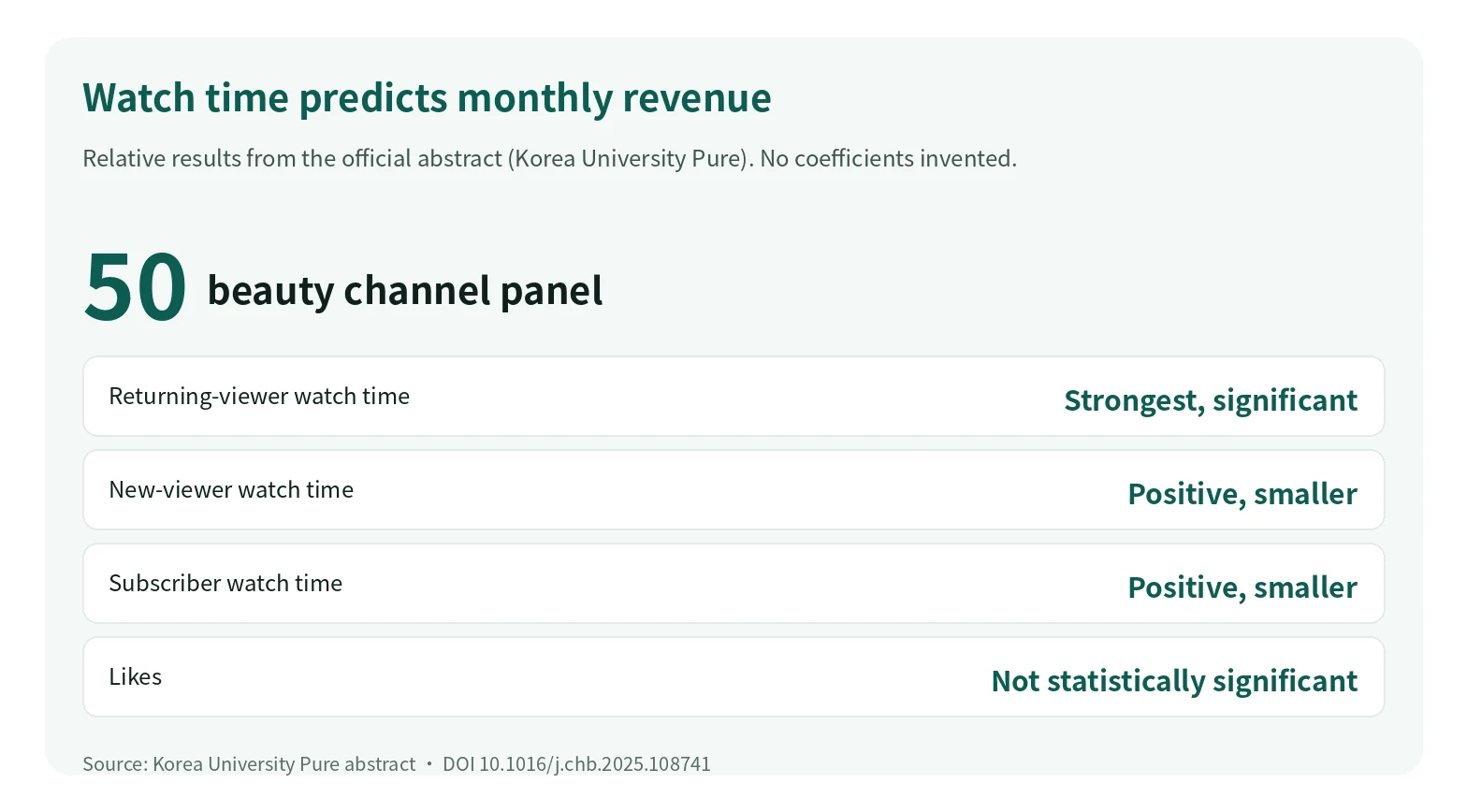
The platform economy has transformed digital media, making platforms like YouTube central spaces for participation and economic exchange. Unlike conventional media models that focus solely on audience size, YouTube's monetization system relies on user engagement metrics that shape algorithmic visibility, directly impacting revenue generation through advertising and commerce. In this context, users are active agents and co-creators of value, influencing YouTube's success through their interactions. This study explores user agency in beauty-focused YouTube revenue through a four-stage framework: cognitive, affective, conative, and active agency. This study analyzed panel data from 50 beauty channels using fixed-effects regression and examined how engagement metrics—new viewer watch time, returning viewer watch time, subscriber watch time, and likes—affect monthly revenue. The analysis employs fixed-effects regression models to capture both the static and dynamic effects of user engagement. Results show that watch time significantly predicts revenue, with returning viewer watch time (affective agency) as the most significant factor. New viewer (cognitive agency) and subscriber (conative agency) watch time contribute positively but less so, while likes (active agency) showed no statistically significant effect. The findings emphasize fostering affective agency by engaging returning viewers while balancing all engagement stages. These insights offer actionable strategies for creators and platforms to optimize revenue in the competitive digital content landscape.
The point, first
Subscriber counts, a spike in views, or a stack of likes are incomplete measures of revenue. The official abstract points most strongly to the time already-converted viewers spend when they come back.
Likes were not statistically significant for monthly revenue in this analysis. For global brand teams buying creator inventory, treating a burst of engagement as the same thing as earnings will skew the brief.
What the study looked at
The official abstract says the authors analysed panel data from 50 beauty channels with fixed-effects regression. The engagement metrics were new-viewer watch time, returning-viewer watch time, subscriber watch time, and likes. The outcome was monthly revenue.
The paper frames user behaviour in four stages: cognitive, affective, conative, and active agency. Returning-viewer watch time is treated as affective agency.
Our research index and some news reports mention a panel of more than 2,100 channel-months. That figure is not in the Korea University Pure abstract text, and we have not checked it against the article body. The chart on this page uses only the 50 channels stated in the abstract.
How we read it for international work
Shorts can still create a first spike in any market. The harder question is whether viewers return for the next video. If a campaign brief only pays for views, you will book one-off traffic as if it were a relationship.
At BEAUS we look at how long returning viewers stayed before we look at view counts. This page is not a substitute for the article itself.
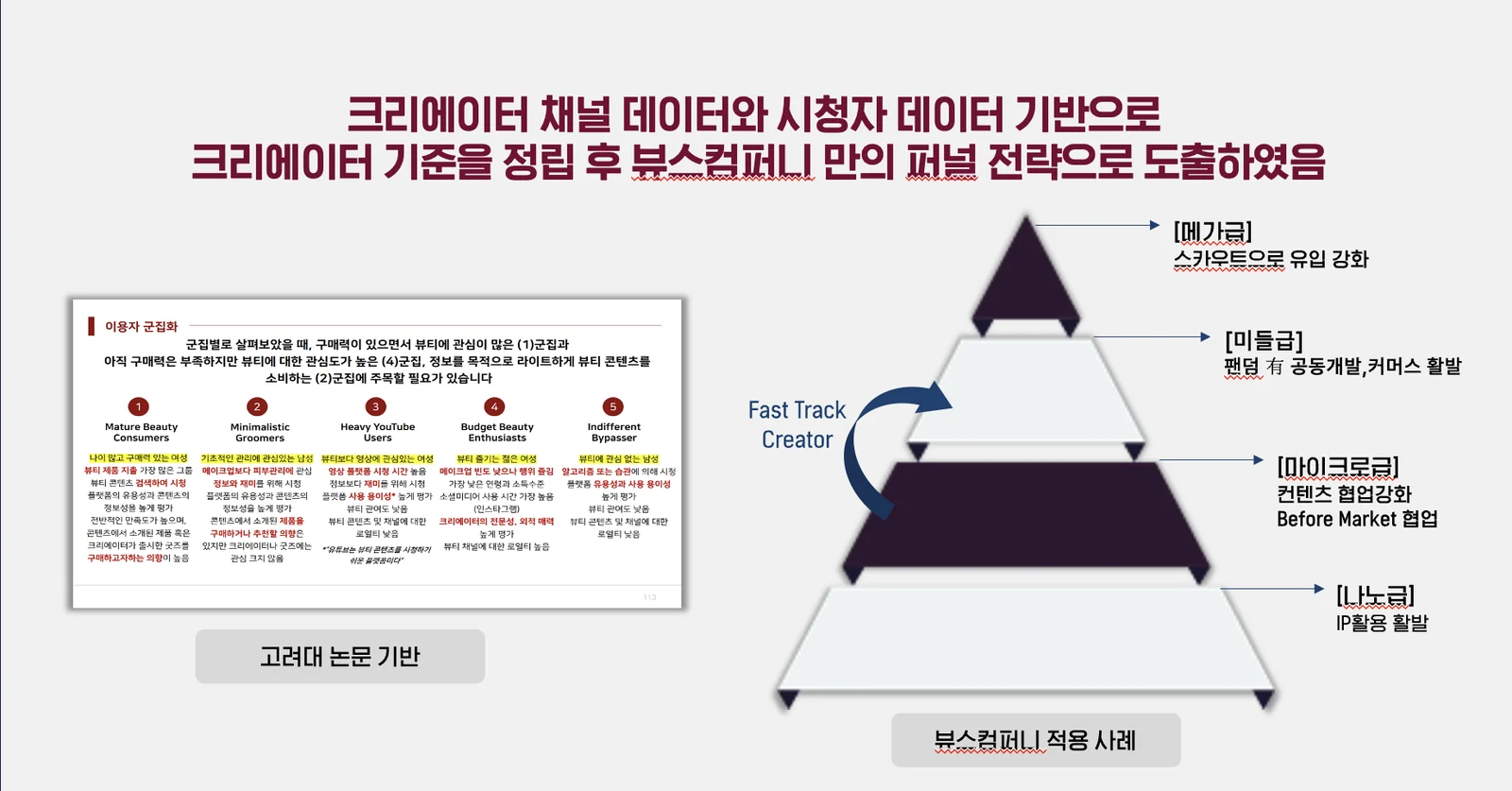
This page is a BEAUS COMPANY explainer. Official wording and figures follow the journal page and the abstract quoted above. Charts show only the direction stated in the abstract; no coefficients were invented.