
Home · Insights · Olive Young skin concerns: split ad creative
Insight · Series “Ad spend leaks before the ad” · Part 3
Olive Young Advertising Agency Notes: Split Ad Creative by Skin Concern
We read 30 subheadings from the monthly Olive Young Trend Report, 14 days of review surveys, concern and discomfort words in reviews, and concern words in product titles across five snapshots. These Olive Young trends show why creative is worth splitting by skin concern. A design table is included.
We think ad creative is worth testing by skin concern, down to the moment that concern shows up, rather than by ingredient or product. Part 1 showed that common ingredient names don’t set products apart. Part 2 showed that “gihoek” (기획, Olive Young’s special bundled set listings) and multi-unit labels are common. This time we look at a different difference: who the product is for and what condition their skin is in. We think switching ads on before the concern and situation are defined is the third point where Olive Young ad spend leaks.
BEAUS COMPANY is one of the agencies listed as “2026 Olive Young ADS Official Partner Agency.” This Part 3 is written from an Olive Young advertising agency’s point of view. It puts four sources side by side: the subheadings of the Olive Young Trend Report that we write every month from store visits, Olive Young review surveys, review keywords and product titles. The definitions behind each number are collected in the evidence table at the end.
Only 1 of 9 skincare subheadings in the monthly report mentioned ingredients
Each issue of the Olive Young Trend Report splits that month’s Olive Young news into 3 subheadings. We sorted the 30 subheadings from the January to October 2026 issues by topic (the classification is BEAUS COMPANY’s). Skincare had 9, makeup 7, wellness and hair/body 6, collaborations 4, and stores, pop-ups and themed promotion events 4.
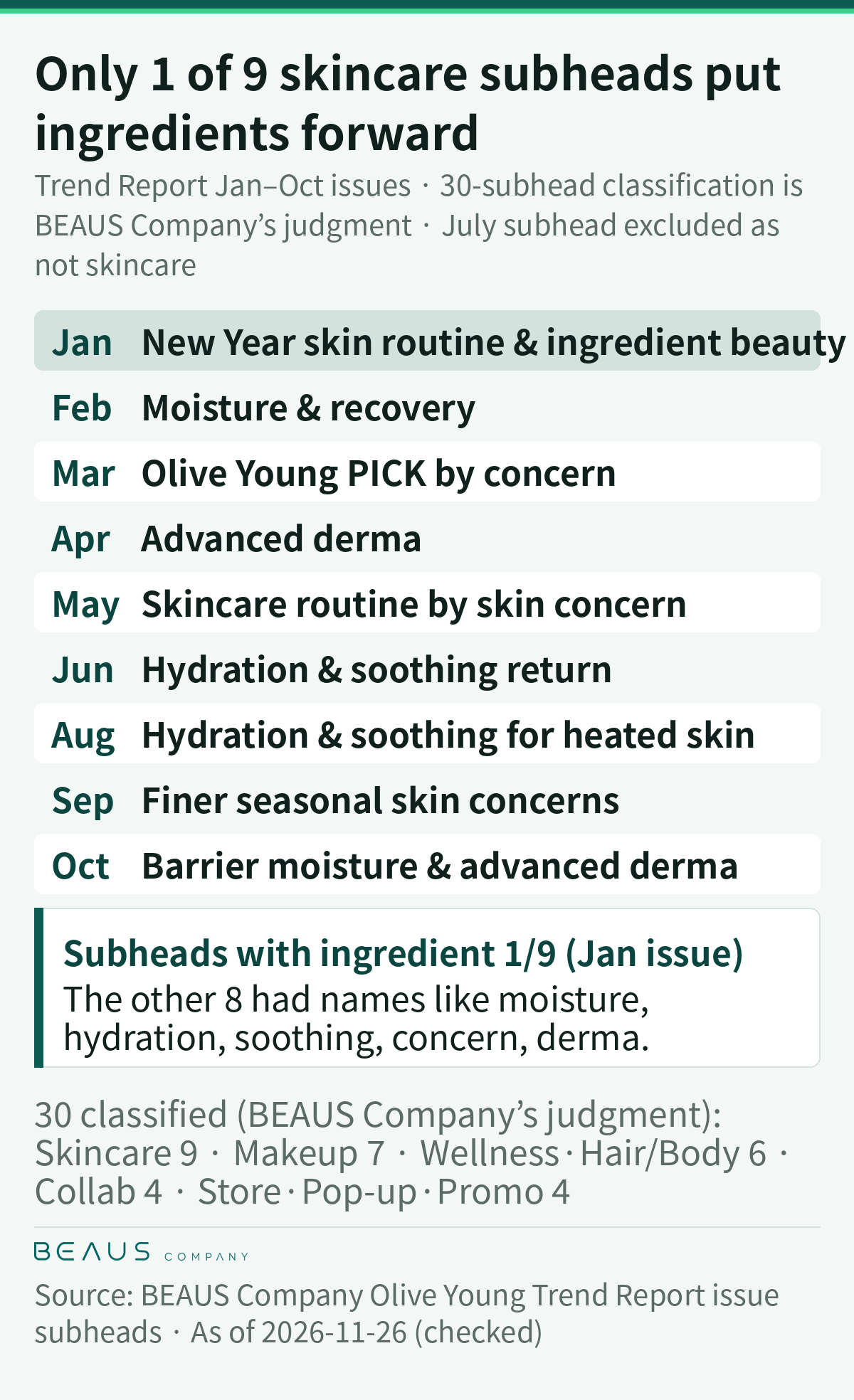
Of the 9 skincare subheadings, only one mentioned ingredients: January’s “New-year skin routine and ingredient-focused beauty.” The rest were February “Moisture and recovery,” March “Olive Young Pick (the store’s picks) by concern,” April “Advanced dermocosmetics,” May “Skincare routines by skin concern,” June “Hydration and soothing return,” August “Hydration and soothing for overheated skin,” September “Seasonal skin concerns, broken down further,” and October “Barrier moisture and advanced dermocosmetics.” After January, all 8 skincare subheadings used a condition or concern, such as moisture, hydration, soothing or barrier, or the name of a line such as derma, not an ingredient. We chose those subheadings ourselves, so this is not a direct measure of change on the shelf. All we can say is that this was the language we used when summarizing Olive Young. Saying “concern is the unit” from our own writing alone would be circular, so below we add review data that is not our own writing.
In some store displays, concern and season come first. These are photos we took ourselves while making the monthly report. Some displays name the situation of use, such as the “Back-to-school Sun Care” corner, which is where Olive Young sunscreen sits.
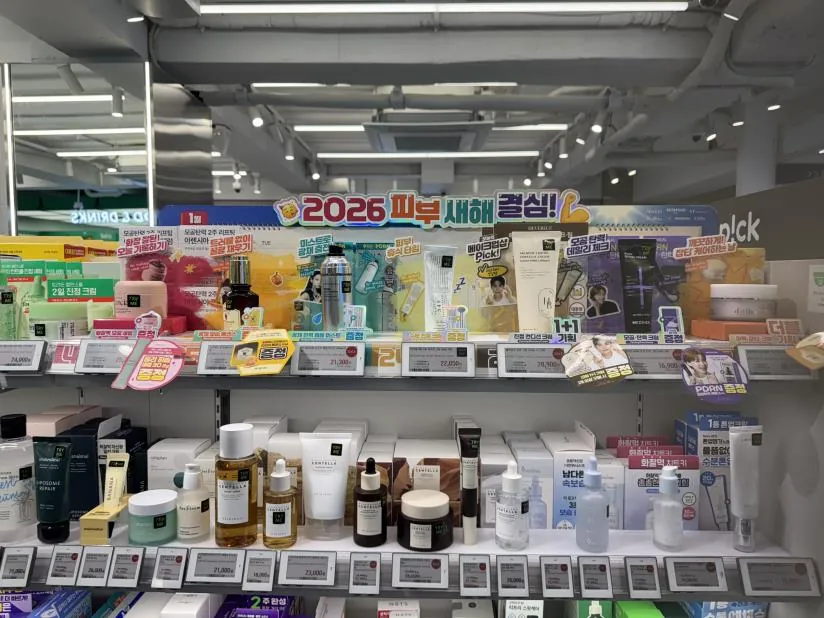
Source: BEAUS COMPANY Olive Young Trend Report, January issue (own photo)
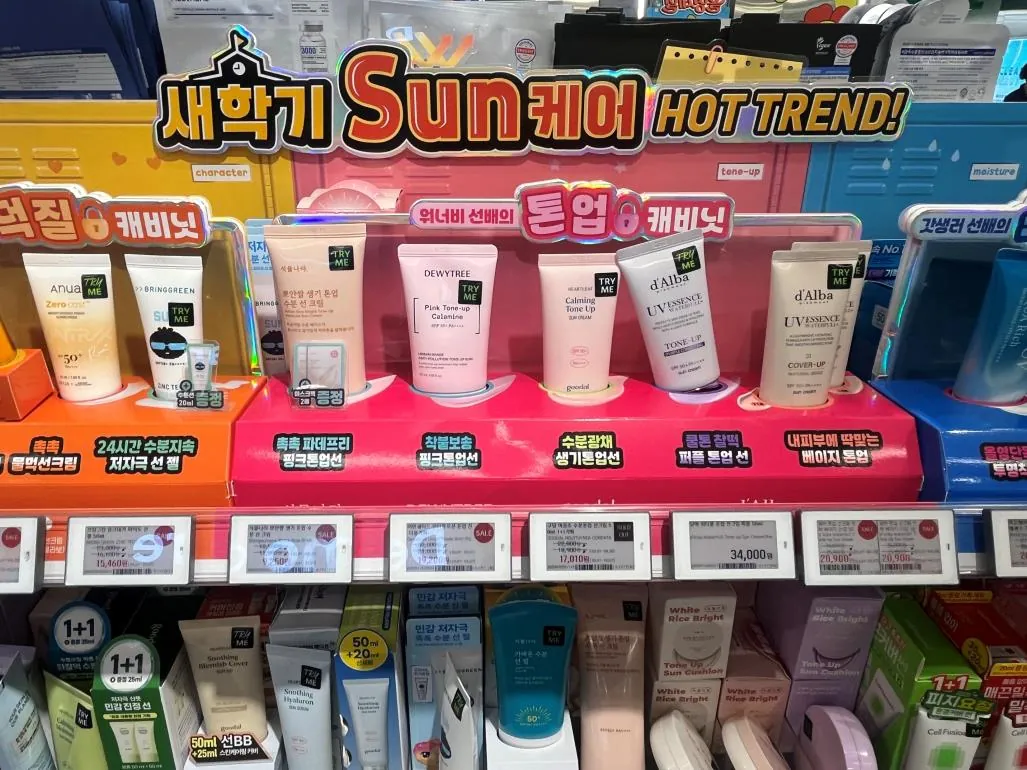
Source: BEAUS COMPANY Olive Young Trend Report, March issue (own photo)
Olive Young skincare review survey: three categories, and moisturizing led
We also looked at how review survey answers were distributed. In the review data collected from 14 to 27 September 2026, 55 to 63 products per day had a “skin concern” survey. The answers counted fell into three categories: moisturizing, calming, and wrinkles/brightening. Counting the most-chosen answer for each product on each day (a “product-day”) over 14 days, moisturizing had 471 (57%), calming 284 (34%) and wrinkles/brightening 76 (9%).
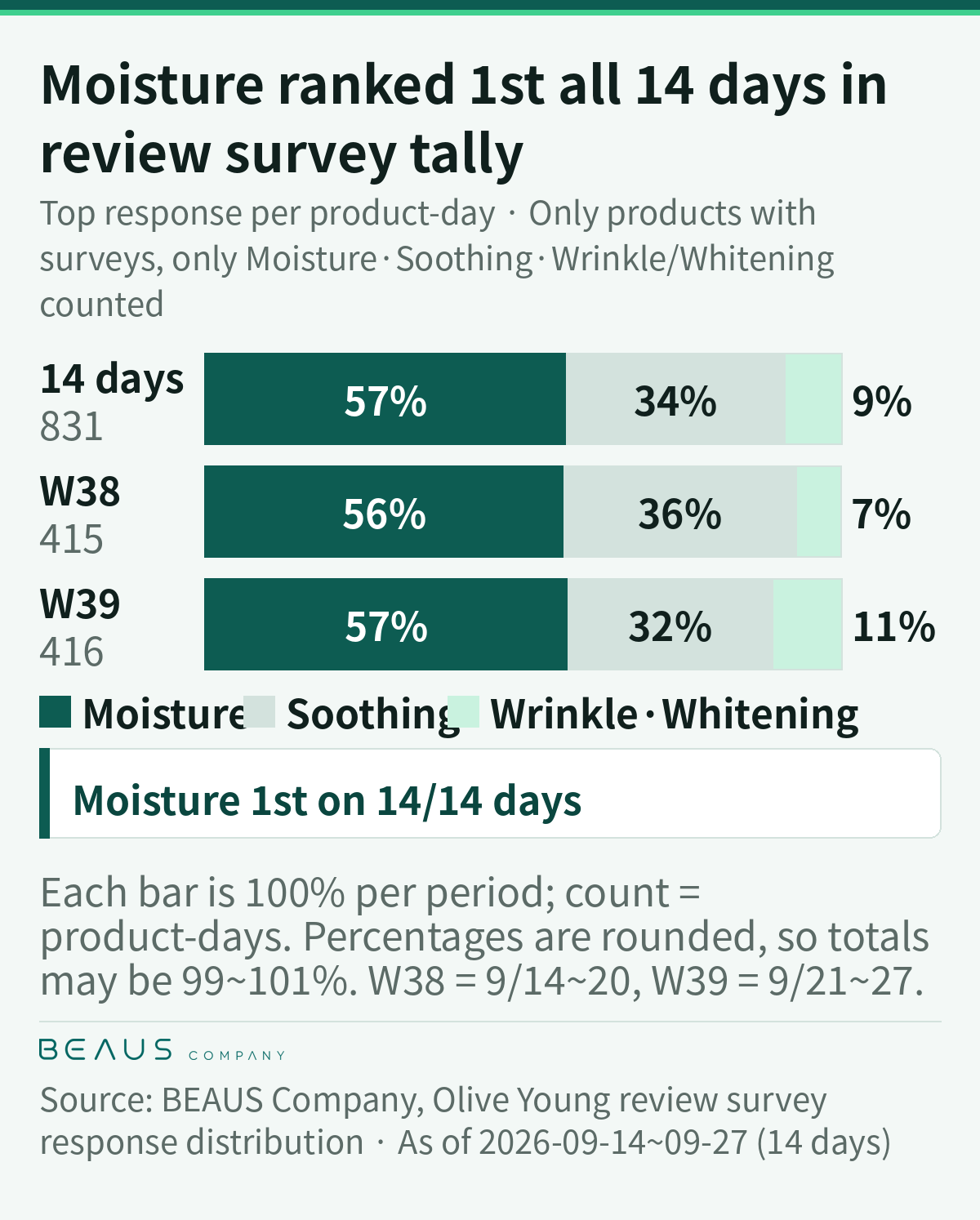
All this table says is that, counted as product-days of top answers, moisturizing was the largest at more than half (57%). The survey records a top answer per product, so it does not tell us what customers want. This table alone also cannot show detailed situations like “feels tight when the seasons change” or “turns red.” Whether such situations really appear can only be checked by reading the review text, so we looked at review keywords next. As Part 1 showed, 36.4% of review texts contained a word describing skin condition (see the evidence table in Part 1).
Which concern and discomfort words come up most in reviews? The same order two weeks running
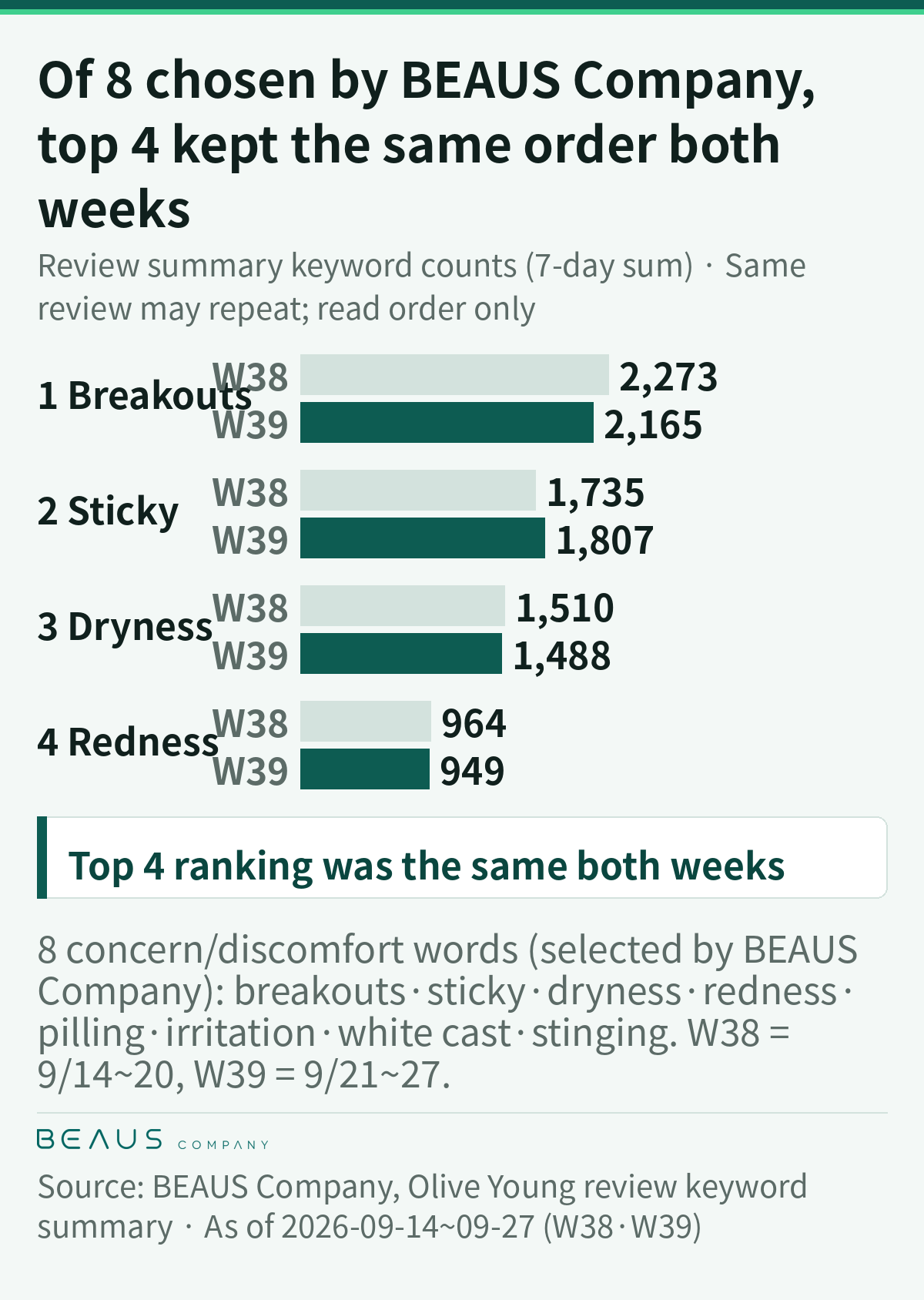
We split the same 14 days into two weeks (W38 is 9/14~20, W39 is 9/21~27). Among the top keywords in the review summaries, we added up 8 words that mean a concern or discomfort (we chose these words). They are breakouts, stickiness, dryness, redness, pilling, irritation, white cast and stinging. Words like “breakouts” can also be caught in positive sentences such as “no breakouts,” so we read them as words that came up often, not as a measure of dissatisfaction. In both weeks, the leading terms were, in order, breakouts, stickiness, dryness and redness. Weekly counts are in the evidence table. The review sample contained 44,715 entries over 14 days, but only 10,270 were unique texts, so the same text is captured again on several days. Keyword sums can also count the same review more than once. We therefore do not read them as unique reviews or customer counts. We only take away that the order was the same.
Even one word like “breakouts” can be several scenes in an ad. For example (a hypothetical example), right after cleansing, or on a day you wore a mask. We think the more finely the scene is divided, the easier it is for customers to read it as their own story.
Product titles already lean on concern words
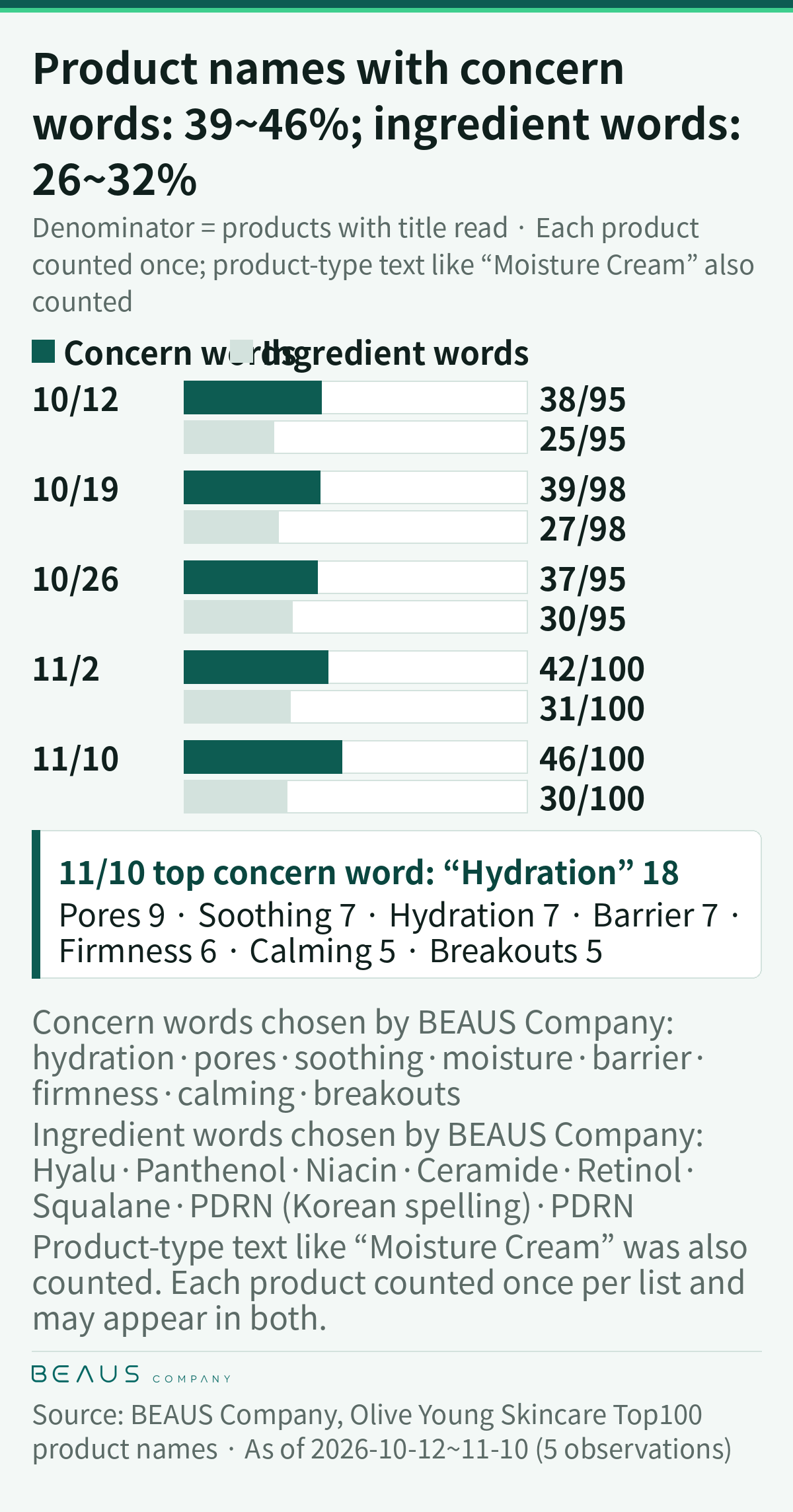
Do top-selling products speak in terms of concerns? We looked at product titles in the Olive Young sales ranking Top 100, saved five times between 12 October and 10 November. We checked eight concern words (we chose these words): hydration, pores, soothing, moisturizing, barrier, firmness, calming and breakouts. Titles containing at least one of them numbered 38 of 95 titles read, then 39 of 98, 37 of 95, 42 of 100 and 46 of 100 across the five snapshots. Titles containing at least one of eight ingredient strings numbered 25, 27, 30, 31 and 30. The strings are matched in Korean title text: hyaluronic (Sodium Hyaluronate, 히알루), Panthenol (판테놀), Niacinamide (나이아신), Ceramide (세라마이드), Retinol (레티놀), Squalane (스쿠알란), and PDRN written in Korean letters (피디알엔) and in Latin letters. On 10 November, the most-used concern word was “hydration,” in 18 products. Please note that some of those characters come from the product type, as in “hydration cream.”
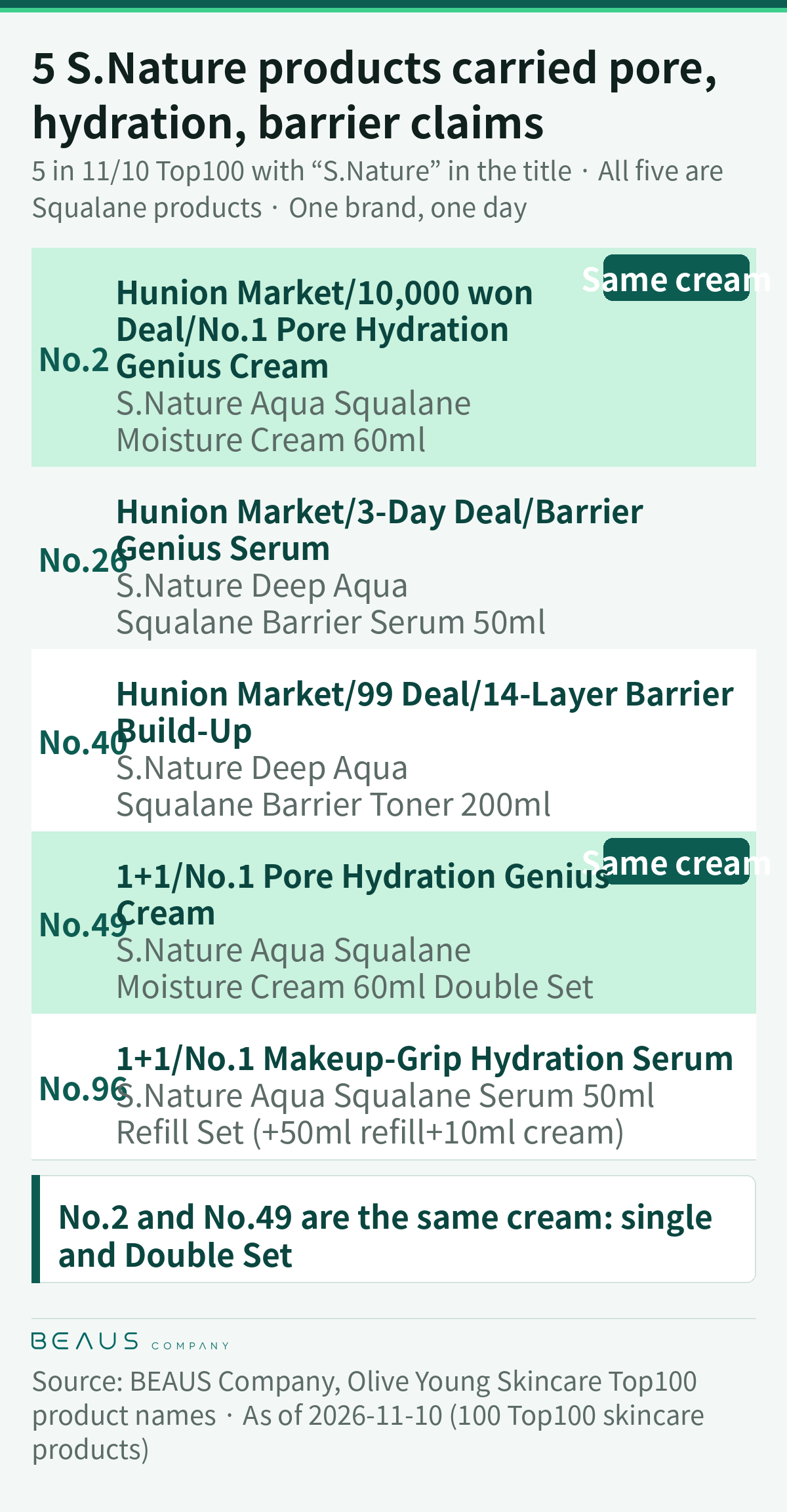
One brand’s product titles illustrate this more clearly. In the 10 November Top 100, 5 products had S.Nature (에스네이처) in the title, and all five had squalane (스쿠알란) in the product name. Yet the bracketed phrases split into pores, hydration and barrier. We keep the Korean names so you can search them on Olive Young Korea: rank 2 1-deung Mogong Subun Cheonjae Cream (1등 모공 수분천재크림), rank 26 Jangbyeok Cheonjae Serum (장벽천재세럼), rank 40 14-jung Sokjangbyeok Build-up (14중속장벽빌드업) and rank 96 1+1 / 1-deung Hwajalmeok Subun Serum (1+1/1등 화잘먹수분세럼). The concern words in them are pores (모공), hydration (수분) and barrier (장벽). Rank 49 is the double gihoek set of the rank 2 cream. In effect, one brand gave different concern names to products on the same ingredient line. This data cannot tell us how those phrases affected sales.
From here on, this is our hypothesis. When ingredient names and concern names overlap across products in similar ways, the ad creative can end up looking similar too. So our proposal is to split by situation once more, even within a single concern.
A concern-by-concern creative plan from an Olive Young advertising agency
The table below is not data. It is a design frame we use for K-beauty marketing strategy, and the example wording is hypothetical. We assume that at the creative-selection stage you look at saves per scene, as in Part 1. After ads are running, you line up three creatives with the same period, the same budget and the same purchase objective, and compare them on orders alone.
| Concern/discomfort word (of the 8 review words) | First scene (example) | What goes in the supporting-evidence column | |---|---|---| | Dryness | Morning when the face feels tight right after cleansing | Moisturizing ingredients, reviews on how it feels to use | | Breakouts | Evening after taking off the mask | Calming ingredients, reviews from breakout-prone skin | | Redness | Night when cheeks flush after cleansing | Calming ingredients, reviews from sensitive skin | | Stickiness | Daytime with sunscreen applied over cream | Texture explanation, order of use |
If it were us, we would start by counting which of these words appears most often in your own product’s reviews. Then we would read several of the review texts containing that word, to check at what moment people use it. Once you identify the situation, write it as one scene and move the ingredients and usage down into the supporting-evidence column. Each creative gets only one concern.
At the ad stage, we make orders the main metric and treat impressions and clicks as supporting. Orders are also affected by price, set composition and promotions, though. So we do not conclude that the creative addressed the right concern just because orders rose. We write down the set composition and promotion terms for the same period, and only decide which scene to test further.
For your next creative, start by finding the concern word in your reviews and writing the moment it appears as one scene.
What to keep in mind when reading this
- We chose how to classify the monthly report subheadings and the word list for product titles. The title words also include characters that come from the product type, as in “hydration cream.”
- The review survey is the product-level top answer across three counted categories. The concern and discomfort words include duplicate samples, so they are not customer counts. Please read them as product-days and keyword tally counts.
- Brands and ranks are exactly as titled in the 10 November 2026 collection, and the wording in the design table is a hypothetical example.
Evidence table
You can check each number in the post against the IDs in the table below. All numbers are values that BEAUS COMPANY counted directly from public information it saved.
| ID | Number in the post | Definition / calculation | Source / reference date |
|---|---|---|---|
| OY3-01 | 30 · 9 · 7 · 6 · 4 · 4 / ingredient 1 | Monthly report subheadings classified by topic | BEAUS COMPANY Olive Young Trend Report, January–October issue subheadings, checked 26 November 2026 |
| OY3-02 | 55–63 products · 471 (57%) · 284 (34%) · 76 (9%), W38 56 · 36 · 7%, W39 57 · 32 · 11%, moisturizing ranked first on 14 of 14 days | Number of products with a skin concern survey; total of top answers by product-day (total 831) | BEAUS COMPANY, daily collection of Olive Young reviews, 2026-09-14 to 09-27 |
| OY3-03 | breakouts 2,273→2,165 · stickiness 1,735→1,807 · dryness 1,510→1,488 · redness 964→949 · pilling 737→723 · irritation 665→718 · white cast 494→531 · stinging 490→445 | 7-day sums of concern and discomfort words (W38→W39) | BEAUS COMPANY, daily collection of Olive Young reviews and keyword summaries, 2026-09-14 to 09-27 |
| OY3-05 | 44,715 · 10,270 | Number of review summary samples over 14 days and, among them, the number of unique texts (same sample as OY1-06 in Part 1) | BEAUS COMPANY, daily collection of Olive Young reviews, 2026-09-14 to 09-27 |
| OY3-06 | Containing a concern word (hydration, pores, soothing, moisturizing, barrier, firmness, calming, breakouts) 38/95 · 39/98 · 37/95 · 42/100 · 46/100; containing an ingredient string (Sodium Hyaluronate (히알루), Panthenol (판테놀), Niacinamide (나이아신), Ceramide (세라마이드), Retinol (레티놀), Squalane (스쿠알란), PDRN in Korean letters (피디알엔), PDRN in Latin letters) 25 · 27 · 30 · 31 · 30 / 11/10 hydration 18 · pores 9 · soothing 7 · moisturizing 7 · barrier 7 · firmness 6 · calming 5 · breakouts 5 | Number of products with the word in the title (spaces removed, overlaps possible); the denominator is the number of products whose title was read | BEAUS COMPANY, Olive Young skincare Top 100 products and full ingredient lists, oy_top100_skincare_20261012~20261110, 2026-10-12 to 11-10 |
| OY3-07 | 5 S.Nature (에스네이처) products: rank 2 1-deung Mogong Subun Cheonjae Cream (1등 모공 수분천재크림), rank 26 Jangbyeok Cheonjae Serum (장벽천재세럼), rank 40 14-jung Sokjangbyeok Build-up (14중속장벽빌드업), rank 49 1+1 / 1-deung Mogong Subun Cheonjae Cream (1+1/1등 모공 수분천재크림, double gihoek set), rank 96 1+1 / 1-deung Hwajalmeok Subun Serum (1+1/1등 화잘먹수분세럼) | Bracketed phrases and product names of the 11/10 Top 100 products with S.Nature in the title | oy_top100_skincare_20261110, 2026-11-10 |
The photos were taken by BEAUS COMPANY while making the Olive Young Trend Report. The numbers only show which values are larger, not why. This is correlation, not causation.
BEAUS COMPANY is one of the agencies listed as “2026 Olive Young ADS Official Partner Agency” (Olive Young Ads official partner agency page, 10 agencies listed as of 25 November 2026). Partner status does not guarantee listing, rankings or sales. If you are comparing an Olive Young advertising agency with a K-beauty performance marketing agency, our Olive Young advertising agency guide covers the ad products and how to get started.
Series: “Ad spend leaks before the ad”
- Part 1: Olive Young skincare ranking: common ingredient names don’t set products apart
- Part 2: Olive Young gift sets: most top-ranked skincare products are “gihoek” special sets
- Part 3: Split ad creative by concern (this post)
Series
Counting the Olive Young Top 100
- 1Olive Young skincare ranking: common ingredient names don’t set products apart
- 2Olive Young gift sets: most top-ranked skincare products are “gihoek” special sets
- 3Olive Young skin concerns: 30 monthly-report subheadings and reviews, so split ad creative by concern
- 4October at Olive Young: a month without a sale, and gift-with-purchase shaped the rankings
Ranking, ingredient and product-title numbers come from BEAUS COMPANY’s count of public Olive Young skincare rankings and full ingredient lists, saved five times between 12 October and 10 November 2026. Reviews and surveys were collected from 14 to 27 September 2026. The report source is the BEAUS COMPANY Olive Young Trend Report, January to October issues, and the store photos are our own photos from the same reports. The partner listing was checked on the Olive Young Ads official partner agency page. The source of our own counts is BEAUS COMPANY. This report is published by BEAUS COMPANY and is not an official Olive Young publication.