
Home · Insights · Olive Young skincare ranking: ingredients
Insight · Series “Ad spend leaks before the ad” · Part 1
Olive Young Skincare Ranking: Common Ingredient Names Don’t Set Products Apart
We counted the ingredient lists of the Olive Young skincare ranking Top 100 over five weeks. Sodium Hyaluronate, Panthenol and Niacinamide were near the top every time. As an Olive Young advertising agency, we put numbers on where ingredient-led ads fall short.
Our conclusion: in the Olive Young skincare ranking (the Olive Young sales ranking Top 100, counted from October to November 2026), ingredient names that repeat across top products can’t explain what makes one product different from another. Of the six ingredients we chose, the top four kept appearing in a similar share of the Top 100 across all five observations. Put those names in an ad headline and you say the same thing as the product next to yours. We think this is where Olive Young ad spend starts to leak: before the ad is switched on. The data in this post does not show ad spend itself, so this is a hypothesis.
BEAUS COMPANY is one of the agencies listed as a “2026 Olive Young ADS Official Partner Agency”. As an Olive Young advertising agency, we are writing this series in three parts. Part 1 covers ingredients, Part 2 covers sets and “gihoek” (기획, Olive Young’s special bundled set listings), and Part 3 covers creative by skin concern. Every number in the post is a value we counted ourselves from the data we collected, and you can check each one in the evidence table at the end.
How we counted
BEAUS COMPANY stores Olive Young rankings and the full ingredient lists from product detail pages. For this post we pulled the skincare ranking Top 100 five times, about a week apart (10/12·10/19·10/26·11/2·11/10). We collected nothing new. We only recounted values from public pages we had already saved. On each date, 0 to 5 products had detail pages we could not read, so the number of products counted (the denominator) is not always 100. For ingredients, we only checked whether the name appears in the ingredient list string.
Between the numbers, here is a set of in-store photos. We took them ourselves while making the Olive Young Trend Report, which BEAUS COMPANY writes every month from store visits. The displays carry large skin-condition headings such as “Skin Condition ON”, and ingredient names such as “PDRN & Retinol” also appear on in-store signage.
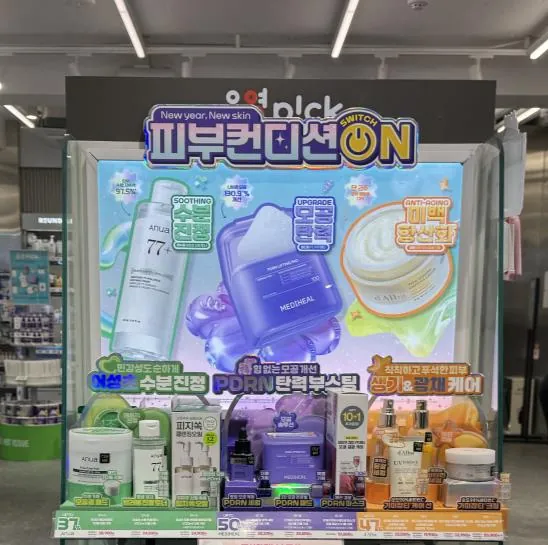
Source: BEAUS COMPANY Olive Young Trend Report, January issue (photographed by us)
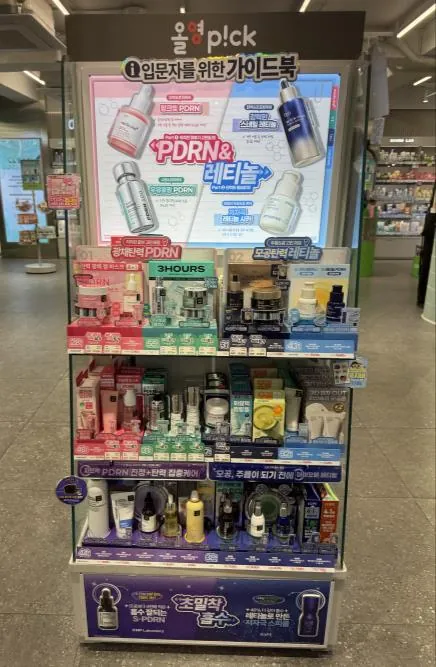
Source: BEAUS COMPANY Olive Young Trend Report, January issue (photographed by us)
Olive Young skincare ranking: six ingredients across five snapshots
All five observations used the same method. As of 10 November, from the functional ingredients in our analysis list, ranked by how many products contained them, we took six: Sodium Hyaluronate (소듐하이알루로네이트), Panthenol (판테놀), Niacinamide (나이아신아마이드), Adenosine (아데노신), Ceramide (세라마이드) and Squalane (스쿠알란). We then counted the earlier four observations with the same six. Because we picked the six on 10 November, their order is partly built in. On other dates, Madecassoside (마데카소사이드) appeared in more ingredient lists than Squalane (30 vs 27 products on 12 October). Even so, within the six we chose, the four leading ingredients held ranks 1–4 in all five observations, with Ceramide and Squalane at 5 and 6.
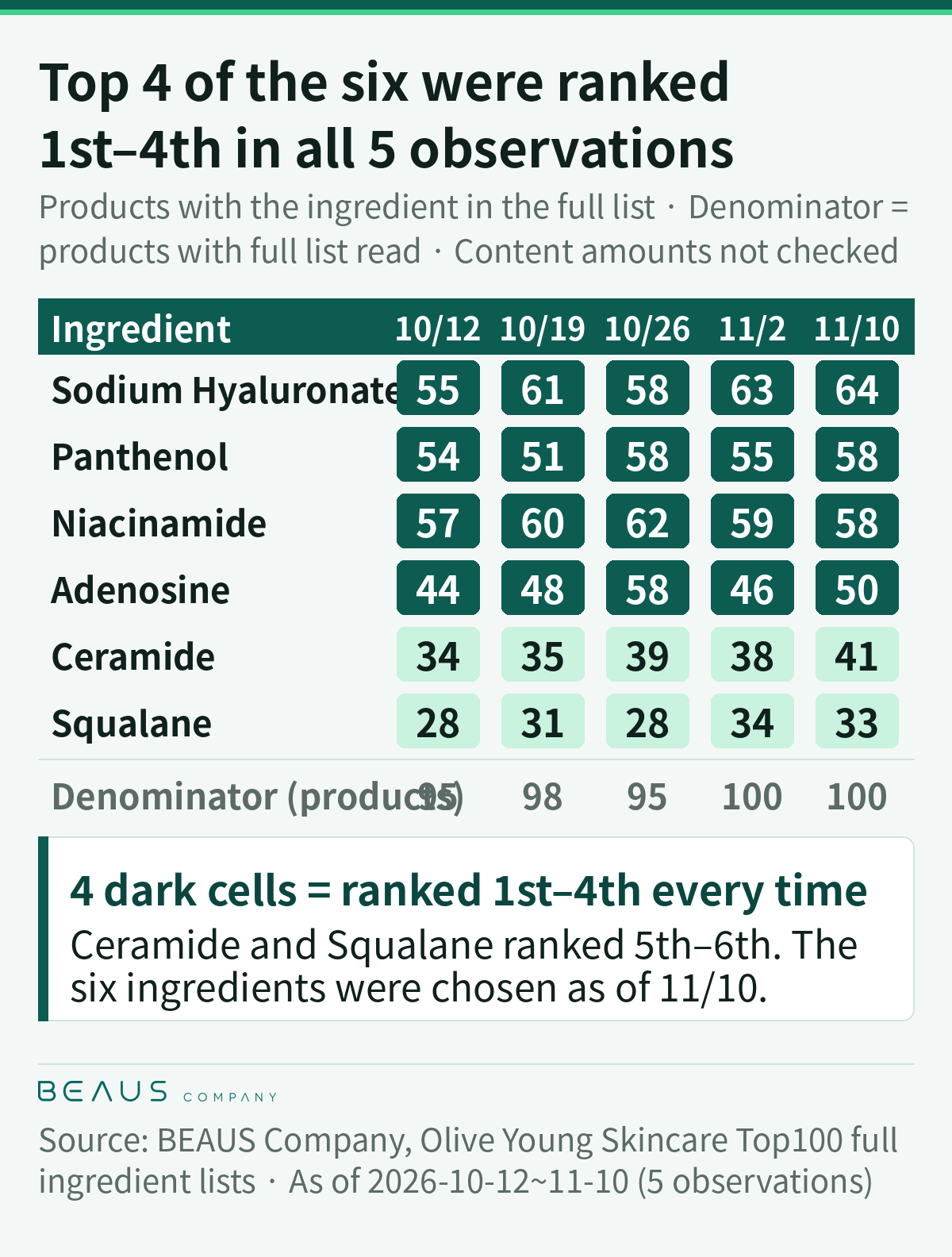
As of 10 November, out of 100 products, 64 contained Sodium Hyaluronate, 58 each contained Panthenol and Niacinamide, and 50 contained Adenosine. Sodium Hyaluronate appeared most often. The range across the five observations was also narrow: Panthenol moved between 51 and 58 products, Niacinamide between 57 and 62. Even as some products entered or left the Top 100 each week, the same four top ingredients kept repeating. A total of 63 products were in the Top 100 on both 2 November and 10 November.
Two ingredients moved. Ceramide rose from 34 to 41 products. Adenosine jumped to 58 on 26 October only, then fell back to 46 the next week. All that says is that Adenosine can swing from week to week. Neither change altered the overall pattern of the top four.
Many products contain at least three of the six ingredients
One ingredient being common is not the same as products having similar combinations. So we also counted how many of the six each product contains together. As of 10 November, 66 products contained three or more, 38 contained four or more, and 23 contained all of Sodium Hyaluronate, Panthenol and Niacinamide.
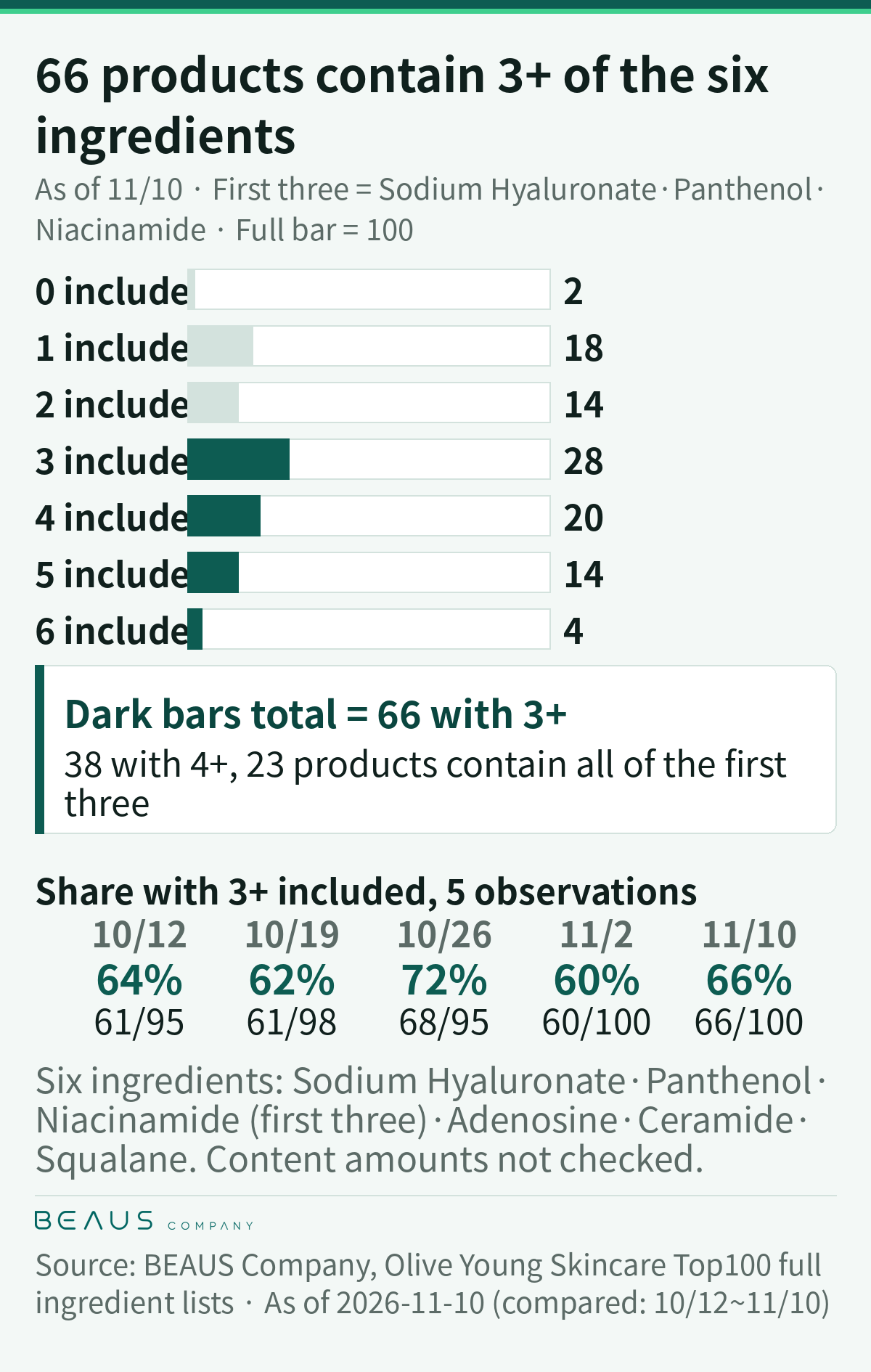
The share of products with three or more of the six was 60–72% across the five observations (10/12: 61, 10/19: 61, 10/26: 68, 11/2: 60, 11/10: 66). If you put Panthenol or Niacinamide in your headline, 58 of 100 products can use the same sentence.
Nine of the top 10 products contain three or more of the six
Averages aside, let’s look at named products. On 10 November 2026, 9 of the top 10 contained three or more of the six ingredients, and none contained all six. By ingredient, Sodium Hyaluronate and Adenosine were in 7 products, Panthenol in 6, and Niacinamide in 5.
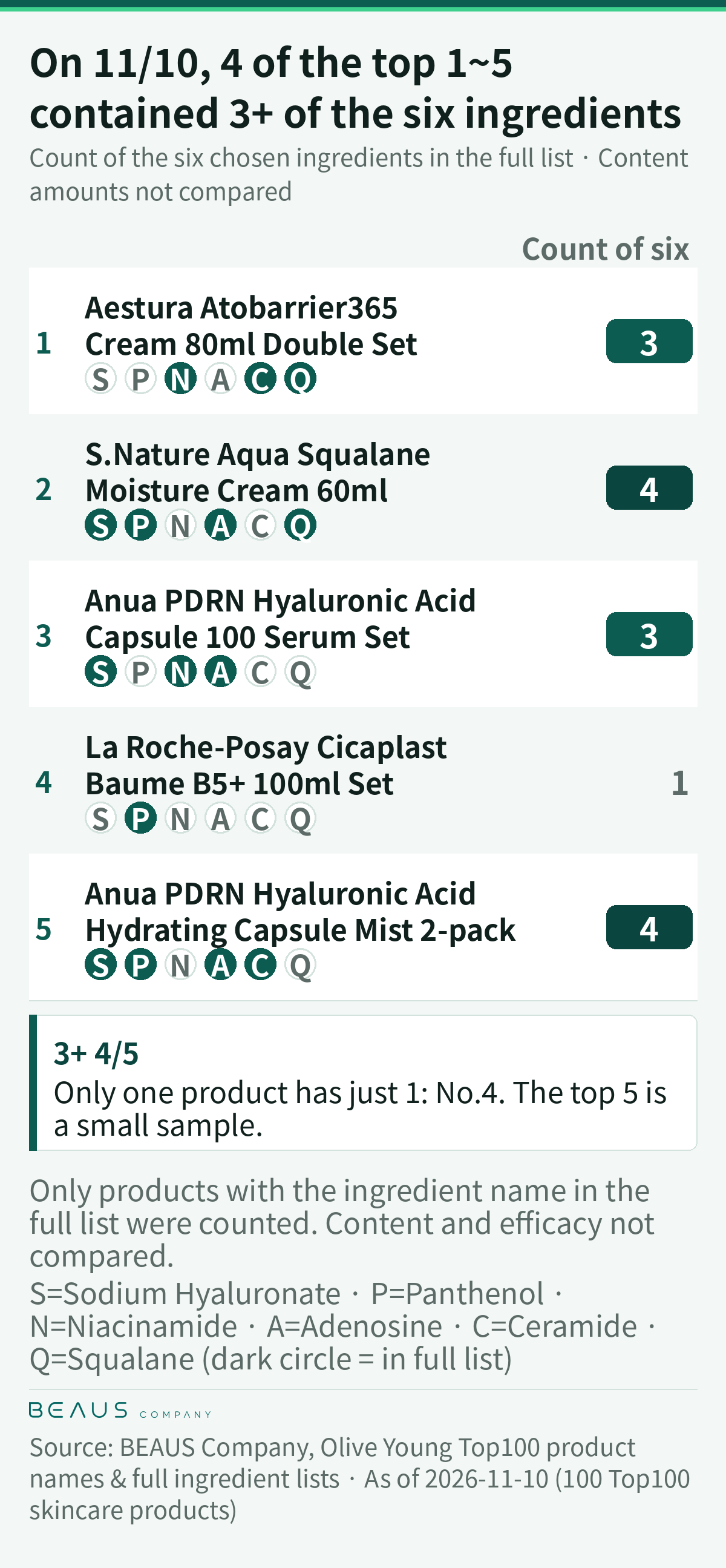
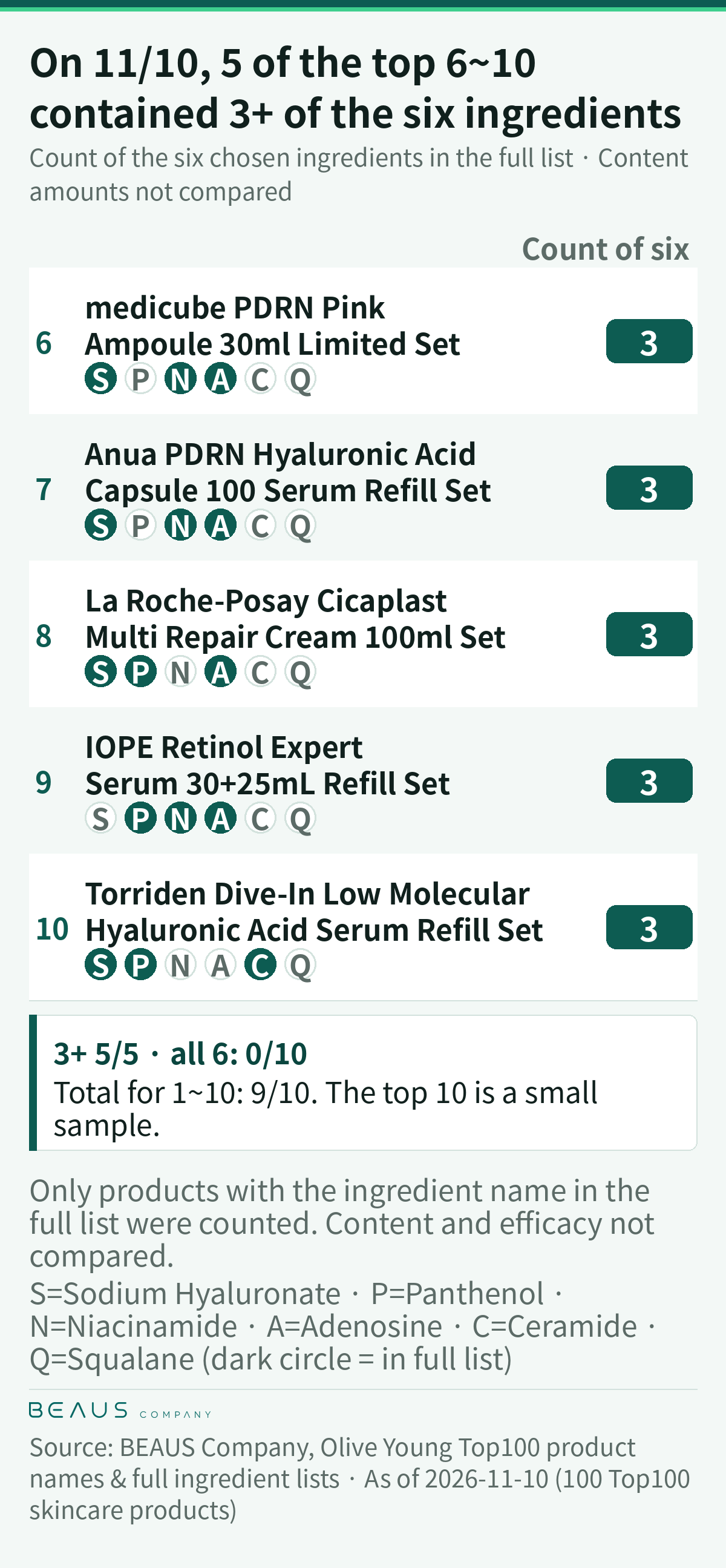
No. 1, Aestura AtoBarrier365 Cream Double Gihoek Set (에스트라 아토베리어365 크림 더블 기획), contained Niacinamide, Ceramide and Squalane. No. 2, S.Nature Aqua Squalane Moisture Cream (에스네이처 아쿠아 스쿠알란 수분크림), contained Sodium Hyaluronate, Panthenol, Adenosine and Squalane. Nos. 3 and 7 are the set and the refill set of Anua PDRN Hyaluronic Acid Capsule Serum (아누아 피디알엔 히알루론산 캡슐 세럼). Both matched on Sodium Hyaluronate, Niacinamide and Adenosine, and No. 6, medicube PDRN Pink Ampoule (메디큐브 PDRN 핑크 앰플), had the same three. By contrast, No. 4, La Roche-Posay Cicaplast Baume B5+ (라로슈포제 시카플라스트 밤 B5+), had just one of the six, Panthenol. These are different products, yet the six ingredients we chose cannot tell Nos. 3, 6 and 7 apart. That is as far as the facts go. This data cannot tell us how ingredient amounts relate to rank. A sample of 10 is small, so please weigh it accordingly.
In reviews, skin-condition words appeared in 36.4% of posts and ingredient names in 6.5%
Now the reviews. From a sample of Olive Young reviews collected from 14 to 27 September 2026, we counted words in 10,270 posts after removing duplicates. We do not publish the original text. We only looked at how many posts contain each word. 3,738 posts (36.4%) contained at least one of ten words describing skin condition and feel: dryness, tightness, soothing, breakouts, redness, irritation, moisturized feel, hydration, barrier and sensitive. 664 posts (6.5%) contained at least one of 14 ingredient names, such as Panthenol, Niacinamide and Ceramide. The most common condition word was “moisturized feel” (촉촉), in 1,483 posts, and the most common ingredient word was “vitamin”, in 130 posts.
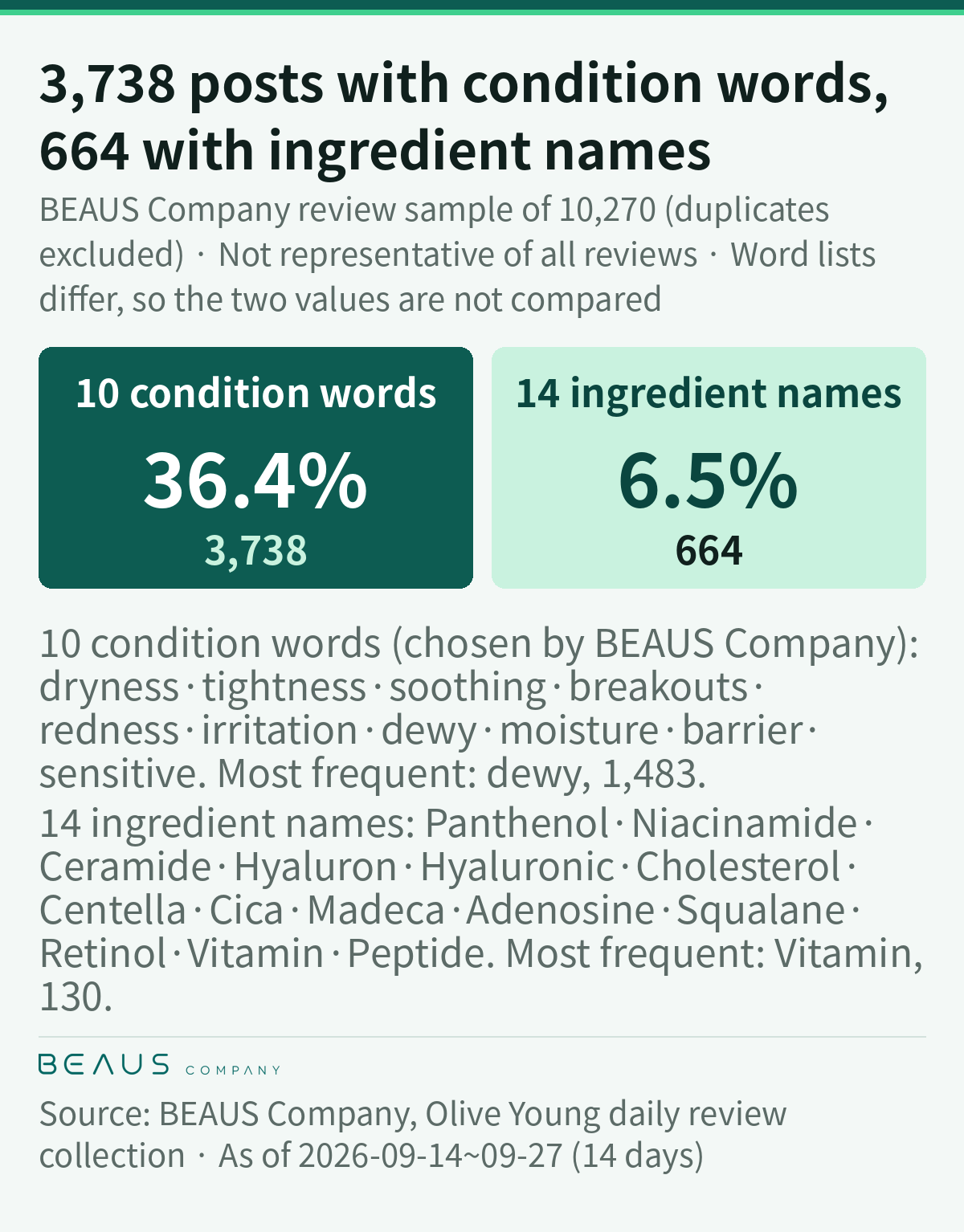
Please don’t read this as customers not caring about ingredients. We chose the word lists ourselves, and the two lists differ in size (10 vs 14 words). The sample also does not represent all reviews. Our reading is limited to one point: in this sample, posts with words about skin condition and how a product feels far outnumbered posts with ingredient names.
Our own monthly reports barely mentioned ingredients after January
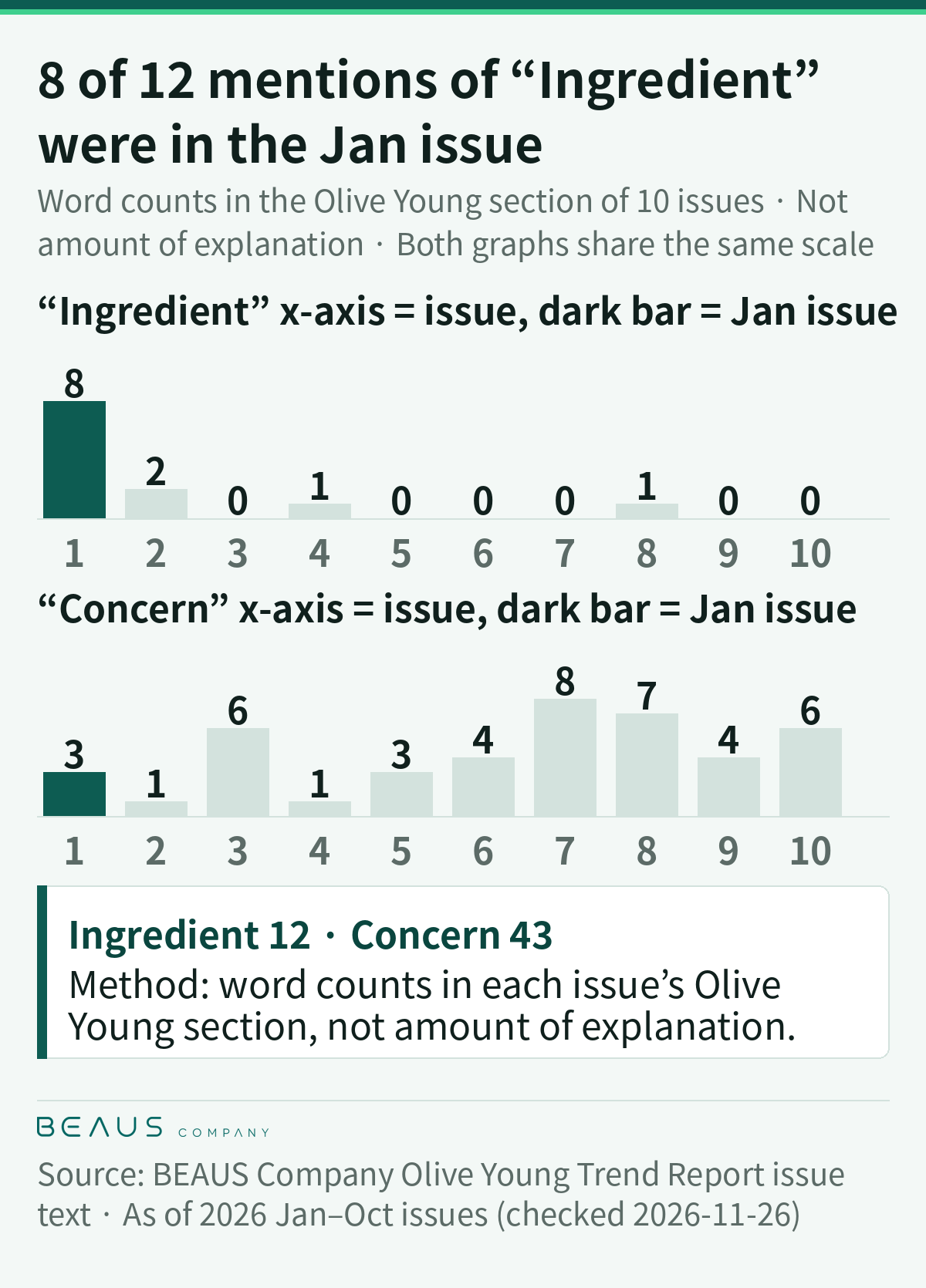
BEAUS COMPANY publishes the Olive Young Trend Report every month. In the Olive Young sections of the January–October issues, the Korean word for “ingredient” (성분) appeared 12 times in total, 8 of them in the January issue. The Korean word for “concern” (고민) appeared 43 times. Of 30 subheadings across the issues, 9 were about skincare, and only one put ingredients up front: “New-year skin routine and ingredient beauty” in the January issue. This data cannot tell us whether Olive Young’s shelves changed or our own focus changed. What we can say is that even in our own monthly write-ups of Olive Young, no skincare subheading led with ingredients after January.
So what changes in an Olive Young advertising agency’s ads?
From here on this is interpretation, not fact.
Ingredient names alone can’t explain how a product differs from the one beside it, so other comparison points such as price or set composition may come first. The data in this post does not show bid prices. Please read it only as a hypothesis about the limits of ingredient-led ads. We are also not saying to drop ingredients. We are saying to move them out of the headline and into the supporting evidence.
If this were your product, we would start by putting its full ingredient list next to the six ingredients above and counting the overlap. On the six alone, 66 of 100 products overlapped on three or more. A product with many overlaps is likely to say the same thing as that group, and we read it no more strongly than that. If the overlap is high, rewrite the headline as “who, for what skin condition, and when to use it”, and move the ingredients below it as supporting evidence. Then make a few short videos or review-style posts from that line, compare saves under the same conditions, and promote the creative with the most saves. At this stage of choosing creative, look at saves only. Metrics after the ad runs (impressions, clicks, orders) come in Part 3.
Here is a hypothetical example (not a real brand). “Contains Panthenol” is a sentence 58 of 100 products can use. “On days your skin feels tight after cleansing and makeup sits unevenly, one layer in the morning” describes the moment of use, not an ingredient name. Write “Contains Panthenol” as supporting evidence under the second line, and the same ingredient now works as proof instead of a headline.
The same test works when you hand this to an agency. Check whether headline alternatives to ingredient names arrive before the ad is switched on.
What to keep in mind when reading this
We only counted whether an ingredient name appears, so we cannot tell how amount relates to rank, and this does not mean customers don’t care about ingredients. The review sample does not represent all reviews, and we chose the word lists. Product names and ranks are exactly as titled in the 2026-11-10 collection, and the top 10 is a small sample. On each date, 0 to 5 products had unreadable detail pages, so denominators differ.
Evidence table
You can check each number in the post by its ID in the table below. Every number is a value BEAUS COMPANY counted itself from public information it saved.
| ID | Number in the post | Definition and calculation | Source and reference date |
|---|---|---|---|
| OY1-00 | Six compared ingredients | BEAUS COMPANY chose the top 6 functional ingredients in the analysis list as of 11/10, ranked by how many products contained them, and counted the earlier four observations with the same six | Same tally, 2026-11-10 |
| OY1-01 | 64·58·58·50 (11/10, denominator 100) | Number of products whose ingredient list contains the ingredient name (matched after removing spaces) | BEAUS COMPANY, weekly tally of Olive Young skincare Top 100 ingredient lists, 2026-11-10 |
| OY1-02 | Sodium Hyaluronate (소듐하이알루로네이트) 55·61·58·63·64, Panthenol (판테놀) 54·51·58·55·58, Niacinamide (나이아신아마이드) 57·60·62·59·58, Adenosine (아데노신) 44·48·58·46·50, Ceramide (세라마이드) 34·35·39·38·41, Squalane (스쿠알란) 28·31·28·34·33 (10/12·10/19·10/26·11/2·11/10) | Products containing the ingredient on each date (5 observations), denominators 95/98/95/100/100 | Same tally, 2026-10-12 to 11-10 |
| OY1-03 | 63 products | Products in the Top 100 on both 11/2 and 11/10 | Same tally, 2026-11-02·11-10 |
| OY1-04 | 66·38·23 (11/10) | Three or more of the six, four or more of the six, and all of the first three ingredients | Same tally, 2026-11-10 |
| OY1-05 | 61·61·68·60·66 (60–72%) | Products with three or more of the six on each date ÷ denominator | Same tally, 2026-10-12 to 11-10 |
| OY1-06 | 10,270·3,738 (36.4%)·664 (6.5%)·moisturized feel (촉촉) 1,483·irritation (자극) 1,051·dryness (건조) 953·vitamin (비타민) 130·cica (시카) 127·hyaluron (히알루론) 120 | Number of de-duplicated review posts containing the word. Ten words describing skin condition and feel = dryness (건조), tightness (당김), soothing (진정), breakouts (트러블), redness (붉어짐), irritation (자극), moisturized feel (촉촉), hydration (보습), barrier (장벽), sensitive (민감). Fourteen ingredient words = Panthenol (판테놀), Niacinamide (나이아신아마이드), Ceramide (세라마이드), hyaluron (히알루론), hyaluronic (히알루로닉), cholesterol (콜레스테롤), centella (병풀), cica (시카), madeca (마데카), Adenosine (아데노신), Squalane (스쿠알란), retinol (레티놀), vitamin (비타민), peptide (펩타이드) | BEAUS COMPANY, daily collection of Olive Young reviews, 2026-09-14 to 09-27 |
| OY1-07 | 12 (8 in the January issue)·43·1 of 9 skincare subheadings about ingredients | Word counts in the Olive Young sections of the monthly reports, and subheading classification | BEAUS COMPANY Olive Young Trend Report, January–October issues, checked 2026-11-26 |
| OY1-08 | Top 10 on 11/10: three or more of the six: 9 · all six: 0 · exactly one of the six: 1 product (rank 4) / Sodium Hyaluronate 7 · Panthenol 6 · Niacinamide 5 · Adenosine 7 · Ceramide 3 · Squalane 2 | Whether the ingredient lists of the top 10 products contain the six ingredient names (rank and product name come from the rank and title fields of the same file) | BEAUS COMPANY, Olive Young skincare Top 100 products and ingredient lists, oy_top100_skincare_20261110, 2026-11-10 |
The photos were taken by BEAUS COMPANY while making the Olive Young Trend Report. The numbers only show which values are more common, not why. This is correlation, not causation.
BEAUS COMPANY is one of the agencies listed as a “2026 Olive Young ADS Official Partner Agency” (Olive Young Ads official partner agency page, 10 agencies listed as of 25 November 2026). If you are comparing Olive Young performance agencies and K-beauty performance marketing agencies, our Olive Young advertising agency guide covers the ad products and how to get started.
Series “Ad spend leaks before the ad”
- Part 1: Olive Young skincare ranking: common ingredient names don’t set products apart (this post)
- Part 2: Olive Young gift sets: most top-ranked skincare products are “gihoek” special sets
- Part 3: Olive Young skin concerns: 30 monthly-report subheadings and reviews, so split ad creative by concern
Series
Counting the Olive Young Top 100
- 1Olive Young skincare ranking: common ingredient names don’t set products apart
- 2Olive Young gift sets: most top-ranked skincare products are “gihoek” special sets
- 3Olive Young skin concerns: 30 monthly-report subheadings and reviews, so split ad creative by concern
- 4October at Olive Young: a month without a sale, and gift-with-purchase shaped the rankings
Ranking, ingredient and product-name numbers are BEAUS COMPANY’s count of public Olive Young skincare rankings and ingredient lists, saved five times from 12 October to 10 November 2026. Review and survey data were collected from 14 to 27 September 2026, and the report figures come from the BEAUS COMPANY Olive Young Trend Report, January–October issues. Store photos are our own, taken for the same report. Partner status was checked on the Olive Young Ads official partner agency page. The source of our own tallies is BEAUS COMPANY. This report is published by BEAUS COMPANY and is not an official Olive Young publication.